
Aerosol filling machines are available for two main packaging systems: standard aerosol and Bag-on-Valve (BOV). Either system can use semi-automatic equipment or a fully automatic line. AILE configurations range from compact semi-automatic equipment rated from 700 cans per hour to customized high-speed lines capable of approximately 200 cans per minute. The correct choice depends on the product formula, packaging structure, valve, filling volume, pressure medium or propellant, required output and desired automation level.
This guide compares the main options so manufacturers and contract fillers can prepare a realistic equipment specification. Capacity figures below are machine ratings; actual output depends on the complete production conditions.
What Are Aerosol Filling Machines?
An aerosol filling machine packages a liquid, cream or other product in a can together with the valve and the required propellant or pressure medium. Depending on the process, aerosol machinery can perform liquid filling, valve placement, valve crimping and propellant or pressure-medium filling.
A complete line may also include leak testing, weight checking, actuator pressing, cap pressing, coding and packing. These stages help turn filled cans into inspected, finished products ready for secondary packaging.
Buyers do not always need every stage from the beginning. A factory may purchase separate liquid filling, crimping or gas filling modules, or specify a complete aerosol filling line with can feeding, inspection and end-of-line equipment. The right scope depends on existing machinery, product risk, output and the level of manual handling the factory accepts.
The Two Main Aerosol Filling Systems
Standard Aerosol Filling System
In a standard aerosol package, the product and propellant are filled into the can according to the selected formula and process. The line normally handles liquid filling, valve placement, crimping and propellant filling, followed by the required inspection and finishing stages.
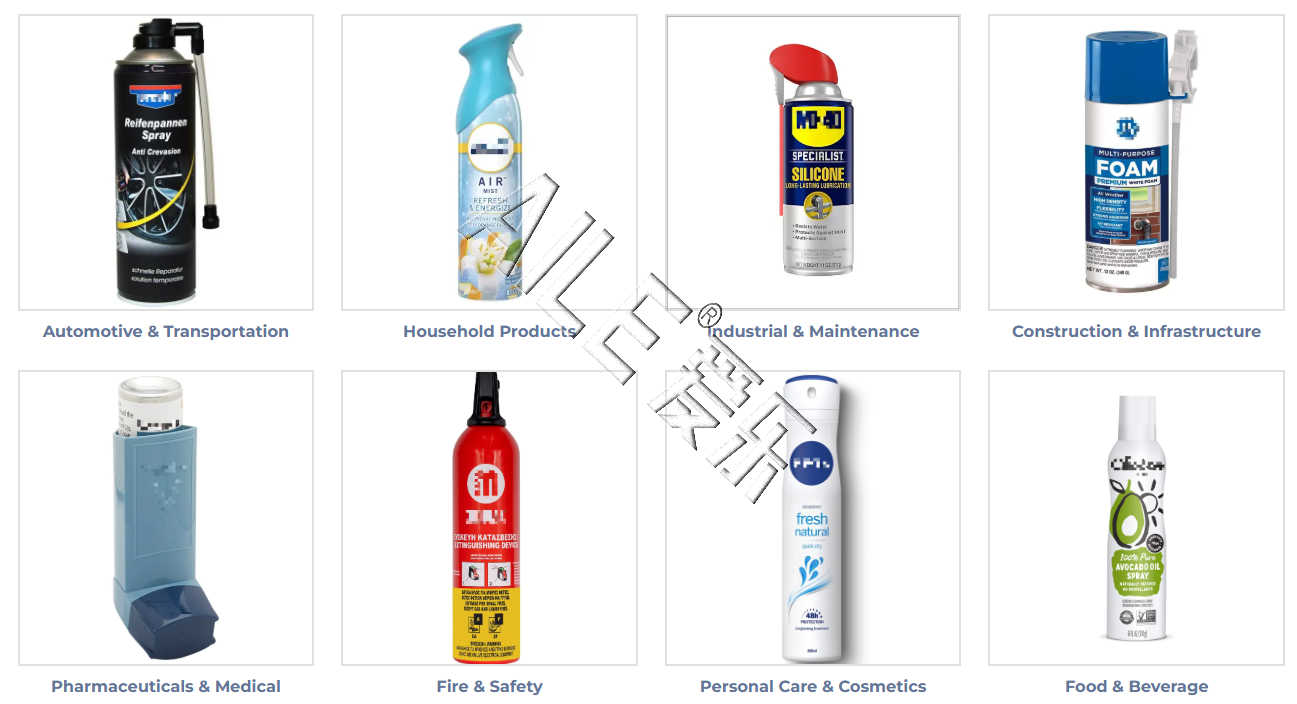
Typical applications include hairspray, body spray, air freshener, insecticide spray, lubricant spray, cleaning spray and spray paint. The final process must still be confirmed for the specific formula, valve and propellant.
Bag-on-Valve Filling System
A BOV package contains a flexible bag attached to the aerosol valve. The product is filled inside the bag, while the pressure medium occupies the space between the bag and the can. The two remain separated.
Because the packaging structure and filling sequence differ from a standard aerosol, a BOV filling machine must be configured for the BOV valve, pressure filling, crimping and filling through the valve. Typical applications include sunscreen spray, nasal spray, cream spray, hydrating mist, olive oil spray and perfume spray.
Standard Aerosol vs BOV
| Comparison item | Standard aerosol | Bag-on-Valve | What the buyer needs to confirm |
|---|---|---|---|
| Packaging structure | Product and propellant are filled into a conventional aerosol package | Product is held inside a bag attached to the valve; pressure medium is outside the bag | Can, valve and package samples or drawings |
| Valve type | Standard aerosol valve selected for the product | BOV valve with an attached bag | Valve specification and supplier |
| Product position | Inside the aerosol can | Inside the flexible bag | Formula and packaging compatibility |
| Propellant or pressure medium | Selected according to the product and process | Commonly compressed air or nitrogen, subject to project confirmation | Medium, target filling volume and operating pressure |
| Filling sequence | Liquid filling, valve placement/crimping and propellant filling as configured | Pressure-medium filling and crimping, then product filling through the valve | Required process and valve behavior |
| Suitable products | Common for personal-care, household, automotive and paint aerosols | Common for mists, creams, edible-oil sprays and other separated-product packages | Product formula, spray result and market requirements |
| Machine configuration | Standalone modules or complete line | Dedicated BOV modules or complete line | Existing equipment and required integration |
| Semi-automatic availability | Yes | Yes | Batch size, labor and changeovers |
| Fully automatic availability | Yes | Yes | Continuous output and automation target |
Standard aerosol, BOV and automation level should not be confused. Standard and BOV are packaging systems; each can be semi-automatic or fully automatic.
Types of Aerosol Filling Machines by Automation Level
Standard Semi-Automatic Aerosol Filling Machine
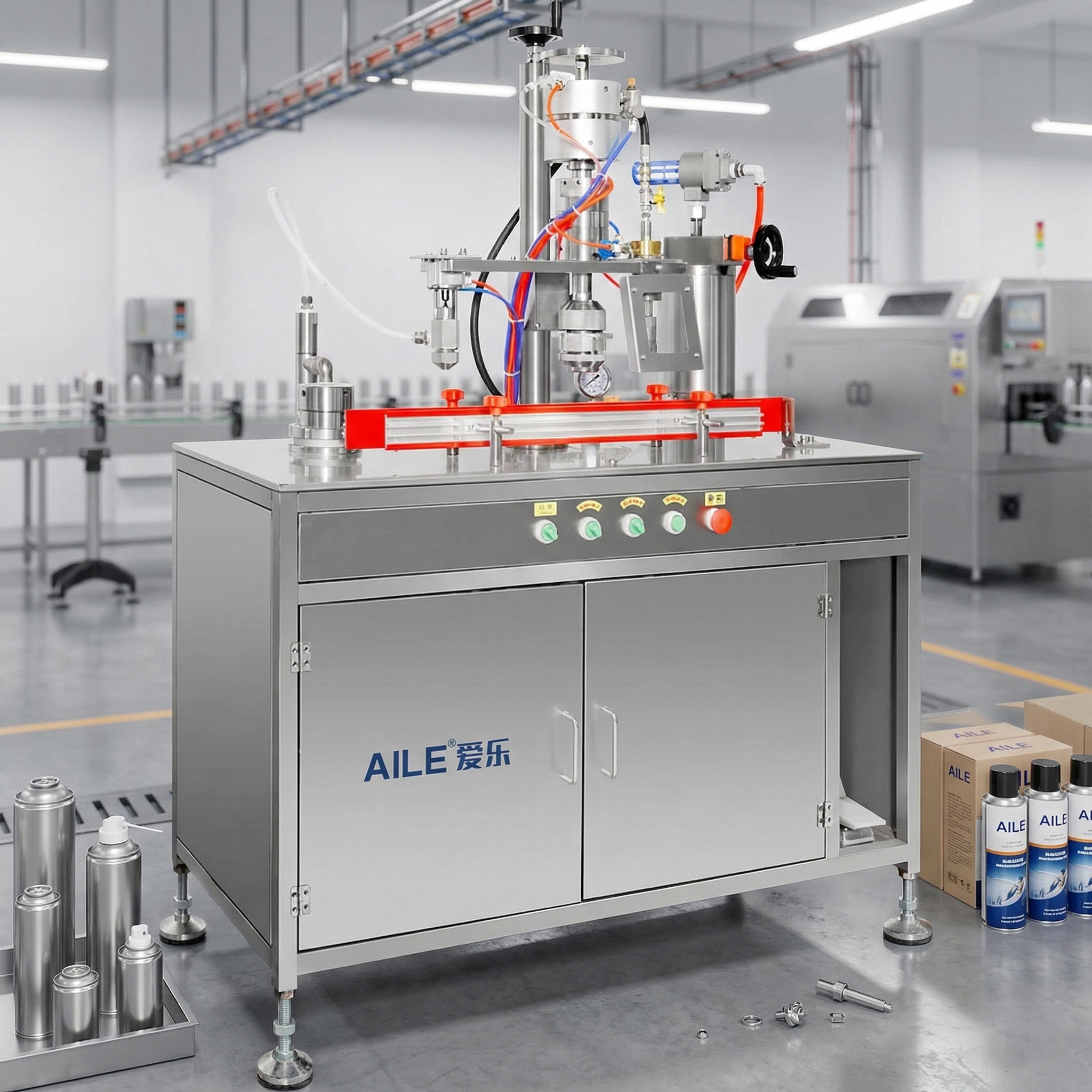
A standard semi automatic aerosol filling machine is rated at 700–1,200 cans per hour. It is often suitable for small and medium production, multiple products and shorter batches. The initial investment is lower than for an automatic line, and manual transfer between workstations can make product changeover more flexible.
One person can operate a semi-automatic line. When higher workflow efficiency is needed, the customer may instead place one operator at each workstation. This option is practical for a factory entering aerosol production or producing several aerosol products without requiring continuous conveyor output.
Standard Automatic Aerosol Filling Line
A standard automatic aerosol filling line is rated at 2,400–3,600 cans per hour. Cans move continuously by conveyor through automatic liquid filling, valve placement, crimping and propellant filling. Inspection, actuator pressing, cap pressing, coding and packaging equipment can be added according to the project.
This configuration is suitable for stable medium-volume production where a consistent product and package are run for longer periods. Changeovers remain possible, but buyers should discuss the number of SKUs, can sizes, valves and formulas because these affect line design and operating time.
High-Speed Automatic Aerosol Filling Line
A high-speed automatic aerosol filling line is rated at 4,800–7,200 cans per hour. AILE can also customize higher-speed lines according to the customer’s capacity, product, safety, layout and downstream requirements.
One verified example is AILE’s approximately 200-cans-per-minute project in Argentina. The official case describes a fully automatic rotary line for a fire-safety aerosol product, arranged in a custom U-shaped layout and including high-speed can feeding, liquid filling, gas filling, water-bath testing, actuator insertion, labeling and packing-related stages. This is a project-specific result, not a standard output guarantee.
Semi-Automatic BOV Filling Machine
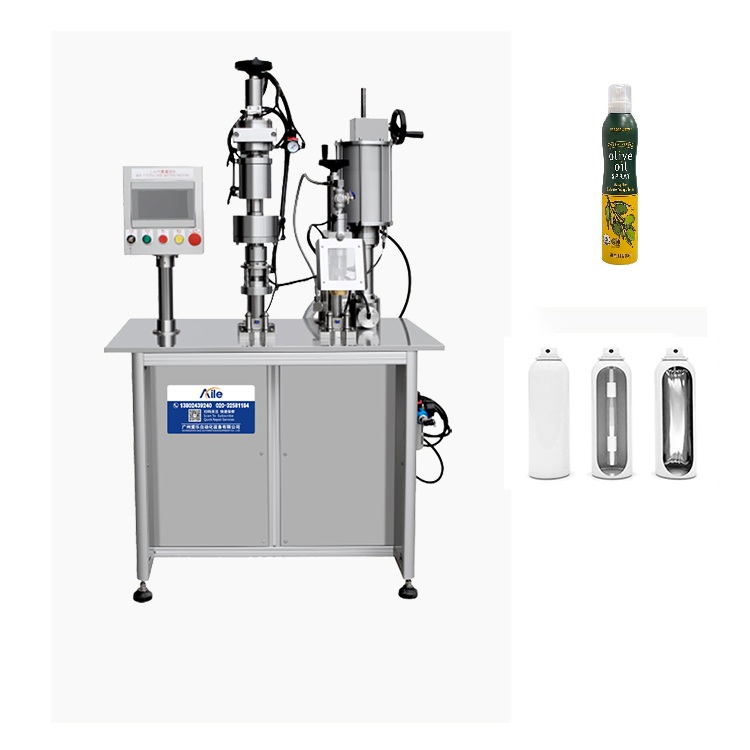
A semi-automatic BOV filling machine is rated at 700–900 cans per hour. It is suitable for smaller BOV production, product trials, multiple products and factories entering the BOV aerosol market. Operators place or move packages through the required pressure filling/crimping and through-the-valve product filling stages.
Its compact arrangement and flexible changeover can be useful where batch variety matters more than uninterrupted output.
Fully Automatic BOV Filling Line
A fully automatic BOV filling line is rated at 1,500–3,200 cans per hour. It is designed for continuous BOV production and can integrate valve handling, pressure filling, crimping, product filling, inspection, actuator pressing and cap pressing.
The complete line must be matched to the BOV valve, bag, can, filling volume, product characteristics and pressure medium. Optional coding and packing equipment can extend automation beyond the filling process.
Aerosol Filling Machine Capacity Comparison
| Machine configuration | Rated capacity |
|---|---|
| Standard semi-automatic aerosol filling machine | 700–1,200 cans/hour |
| Standard automatic aerosol filling line | 2,400–3,600 cans/hour |
| High-speed automatic aerosol filling line | 4,800–7,200 cans/hour |
| Customized high-speed line | Up to approximately 200 cans/minute, depending on the project |
| Semi-automatic BOV filling machine | 700–900 cans/hour |
| Fully automatic BOV filling line | 1,500–3,200 cans/hour |
Actual production output can be affected by can dimensions, liquid filling volume, product flow characteristics, propellant or pressure-medium filling volume, valve feeding, operator workflow, product changeover, inspection requirements and packing speed. Buyers should therefore distinguish the machine’s rated capacity from planned saleable output.
How Many Operators Are Required?
| Line type | Typical labor arrangement | Automation options |
|---|---|---|
| Semi-automatic line | One person can operate the line; one operator may be assigned to each workstation for higher workflow efficiency | Manual handling can be retained for flexibility |
| Conventional automatic line | Normally 1–2 people feed empty cans into the can unscrambler or feeding system, and 1–2 people pack finished cans at the packing table | Automatic can loading and feeding can reduce manual input |
| Higher-automation line | Staffing depends on the complete configuration and supervision requirements | Automatic can loading, can feeding, case packing and other end-of-line equipment are available |
A fully automatic line should not automatically be described as a zero-worker system. Operators may still load materials, monitor production, replenish valves or caps, perform quality checks and manage finished cases. The final staffing plan depends on what is included before and after the core aerosol can filling machine.
Which Aerosol Filling Machine Is Suitable for Your Product?
| Product | Typical packaging system | Recommended machine configuration | Important information to confirm |
|---|---|---|---|
| Hairspray | Commonly standard aerosol | Semi-automatic or automatic standard line | Formula, valve, propellant, volume and output |
| Body spray | Commonly standard aerosol | Semi-automatic or automatic standard line | Alcohol content, valve, can and propellant |
| Air freshener | Commonly standard aerosol | Standard aerosol filling equipment | Formula, spray format and target capacity |
| Insecticide spray | Commonly standard aerosol | Standard semi-automatic or automatic line | Formula handling, valve, propellant and inspection |
| Lubricant spray | Commonly standard aerosol | Standard automatic line or flexible semi-automatic set | Viscosity, filling volume, valve and actuator |
| Cleaning spray | Commonly standard aerosol | Standard line; final selection depends on formula | Material compatibility, propellant and inspection |
| Spray paint | Commonly standard aerosol | Standard line configured for paint | Formula flow, mixing needs, valve and actuator |
| Sunscreen spray | BOV is a typical option | Semi-automatic or automatic BOV line | Formula, BOV valve, bag, volume and pressure medium |
| Nasal spray | BOV is a typical option | BOV filling equipment | Package, valve, formula and quality requirements |
| Cream spray | BOV is a typical option | Semi-automatic or automatic BOV line | Viscosity, valve, filling method and output |
| Hydrating mist | BOV is a typical option | BOV line matched to batch volume | Valve, spray result, can and pressure medium |
| Olive oil spray | BOV is a typical option | Semi-automatic or automatic BOV line | Oil flow, BOV package, fill volume and output |
| Perfume spray | BOV is a possible typical option | BOV equipment; confirm final packaging | Formula, valve, package and desired spray |
These are selection starting points, not absolute rules. The final recommendation depends on the actual packaging and formula.
How to Choose the Correct Production Capacity
Start with required cans per day, then divide that demand by realistic production hours. Confirm working hours per shift, number of shifts, number of products or SKUs, changeover frequency, available operators, future expansion and the desired level of inspection and packing automation.
Example 1: A small manufacturer producing several products and requiring fewer than 5,000–10,000 cans per day may consider a semi-automatic line. Its rated capacity and changeover flexibility can suit shorter batches, provided the planned shift time includes setup, cleaning, material replenishment and inspection.
Example 2: A factory requiring stable medium-volume production may consider a standard automatic line rated at 2,400–3,600 cans per hour. It becomes more practical when the same can, valve and formula can run continuously and when upstream material supply and downstream packing can support the line.
Example 3: A large manufacturer requiring continuous high-volume output may consider a 4,800–7,200-cans-per-hour line or a customized high-speed line. The factory must also confirm feeding, inspection, packing, utilities, safety measures and layout so that auxiliary stages do not become bottlenecks.
These examples are planning references, not guaranteed production results. Final selection must also consider filling volume, packaging, formula and operating conditions.
Semi-Automatic vs Fully Automatic Aerosol Filling Machines
| Decision factor | Semi-automatic | Fully automatic |
|---|---|---|
| Production capacity | Lower rated range | Medium to high rated range |
| Initial investment | Lower | Higher; depends on complete line scope |
| Labor arrangement | One person possible; more operators can improve flow | Staff commonly required at feeding and packing unless optional automation is added |
| Factory space | Compact | More space for conveyors and auxiliary equipment |
| Product changeover | Generally flexible for multiple small batches | Best suited to longer, stable runs; changeovers must be planned |
| Production continuity | More manual transfer | Continuous conveyor operation |
| Expansion options | Modules can be added where compatible | Inspection, feeding and packing stages can be integrated |
| Inspection automation | Optional or separate | Online inspection can be integrated |
| Packing automation | Commonly manual or optional | Automatic case packing is available |
| Suitable customer type | New producers, small/medium factories, multi-SKU plants | Contract fillers and manufacturers with stable medium/high demand |
Real AILE Aerosol Filling Machine Projects
Argentina: High-Speed Fire-Safety Aerosol Line
The customer was an Argentine fire-safety aerosol manufacturer seeking approximately 200 cans per minute and needing a line that would fit an existing constrained factory. AILE supplied a fully automatic rotary configuration with high-speed can feeding, filling, gas handling, water-bath leak testing and finishing equipment. Special customization included a U-shaped conveyor layout, an isolated gas-filling area and handling for an L-type actuator. The official case records sustained operation at approximately 200 CPM. Read the Argentina high-speed line case.
Panama: BOV Filling for Edible Oil
The Panama customer produced edible-oil sprays and needed to replace manual filling with a more consistent BOV process. AILE supplied a compact BOV aerosol filling machine using pressure filling/crimping followed by through-the-valve liquid filling. The configuration was matched to oil handling and BOV packaging. The official case reports a machine rating of 700–1,000 fills per hour and verified operation above 800 fills per hour in the described project. Read the Panama edible-oil BOV case.
Australia: Semi-Automatic Deodorant Spray Project
An Australian small manufacturer needed to move deodorant spray production from manual filling to a more controlled process. AILE supplied a semi-automatic three-in-one aerosol filling machine and customized it for the customer’s product viscosity and package size. The official case reports a final filling precision of ±0.5 g after implementation. Read the Australian semi-automatic aerosol project.
Information Buyers Should Provide Before Requesting a Quotation
Prepare the following checklist:
- Product name
- Product formula or flow characteristics
- Can diameter and Can height
- Liquid filling volume
- Propellant or pressure medium and filling volume
- Aerosol valve type
- Required cans per hour / cans per day
- Working hours and Available workers
- Power supply
- Required inspection and packing equipment
- Factory layout or available space
This information helps AILE recommend an accurate machine configuration rather than quoting a generic aerosol can filler that may not match the package or production target.
Conclusion
Selecting aerosol filling machines starts with the packaging system, then the product, valve, filling volume, pressure medium, output and automation target. A compact semi-automatic unit may suit varied small batches, while stable or high-volume production may justify an automatic or customized line.
For a project recommendation, send AILE your product, can dimensions, filling volume, propellant or pressure medium, required capacity and automation requirement. AILE can then recommend a suitable semi-automatic, automatic or customized aerosol filling solution.
Frequently Asked Questions
1. How many cans can a semi-automatic aerosol filling machine produce?
AILE’s standard semi-automatic aerosol filling machine is rated at 700–1,200 cans per hour. The semi-automatic BOV version is rated at 700–900 cans per hour. Actual output depends on the can, filling volume, formula flow, operator workflow, valve handling, inspection and packing. These ratings should therefore be used for initial selection, not treated as guaranteed finished output.
2. What is the capacity of an automatic aerosol filling line?
A standard automatic line is rated at 2,400–3,600 cans per hour, while a high-speed automatic line is rated at 4,800–7,200 cans per hour. A fully automatic BOV line is rated at 1,500–3,200 cans per hour. AILE can also engineer customized high-speed lines when the standard capacity range does not meet the project.
3. What is the difference between standard aerosol and BOV filling?
The main difference is the packaging structure and corresponding filling process. In BOV packaging, the product sits inside a bag attached to the valve and remains separated from the pressure medium outside the bag. Standard aerosol uses a conventional aerosol package and process. Both systems can be supplied as semi-automatic or fully automatic equipment.
4. Can one person operate a semi-automatic aerosol filling machine?
Yes. One person can operate an AILE semi-automatic line. The customer may also assign one operator to each workstation when faster handling is required. The best arrangement depends on the number of stations, package handling, material replenishment, inspection work and the required daily output.
5. How many workers are required for an automatic line?
A conventional automatic aerosol filling line normally uses 1–2 people to place empty cans into the unscrambler or feeding system and 1–2 people at the packing table. Automatic can loading, can feeding and case packing can reduce those manual tasks. Final staffing depends on the complete line, quality-control plan and local operating practice.
6. Can AILE customize a 200-cans-per-minute line?
Yes. AILE has completed a project in Argentina capable of approximately 200 cans per minute. The official case used a fully automatic rotary line with a custom U-shaped layout and project-specific feeding, filling, gas-handling, inspection and finishing equipment. A new 200-CPM request still requires engineering review of the product, propellant, package, layout and safety conditions.
7. Can one aerosol filling line produce different products?
Often, yes, if the products, cans, valves, filling ranges and process requirements are compatible with the selected equipment. Change parts, cleaning and setup may be required. Buyers should list every planned SKU before quotation so AILE can assess compatibility and estimate the practical changeover procedure rather than assuming one setup fits every product.
8. What information is needed before receiving a quotation?
Provide the product and formula characteristics, can diameter and height, liquid and propellant filling volumes, valve type, propellant or pressure medium, hourly and daily output, working hours, available labor, power supply, inspection and packing needs, and factory space. Samples or technical drawings may also be requested during engineering confirmation.
Ready to Optimize Your Aerosol Production?
Contact AILE today to get a customized equipment configuration and technical quotation tailored to your specific formula and capacity requirements.
Get a Free Technical Consultation & Quote