
Precision Emulsification and Homogenization for Uniform Lotion Quality
Precision emulsification and homogenization are critical for achieving the uniform texture and stability that consumers expect from high-quality lotions. The following techniques ensure optimal particle dispersion and microstructure.
High-shear mixing and vacuum homogenization for optimal particle dispersion
High-shear mixing and vacuum homogenization are core technologies for achieving optimal particle dispersion in cosmetic lotions. High-shear rotors generate intense mechanical forces—impact, cavitation, and turbulence—that break oil droplets into micron-sized particles. Simultaneously, vacuum homogenization removes entrapped air, preventing oxidation, foam formation, and microbubble-related instability. This dual process yields droplet sizes typically between 1 and 5 microns, ensuring a smooth, luxurious texture and rapid skin absorption. By eliminating air early, manufacturers can reduce reliance on antioxidants and other stabilizers—lowering formulation costs without compromising shelf life. Critically, the narrow particle size distribution directly supports batch-to-batch uniformity, reinforcing premium brand credibility. Research published in the Journal of Cosmetic Science confirms that vacuum-homogenized emulsions demonstrate up to 30% greater physical stability compared to atmospheric processing—particularly under accelerated aging conditions.
Impact of controlled shear rates and residence time on emulsion microstructure
The microstructure of an emulsion—how droplets are arranged, stabilized, and distributed—depends critically on shear rate and residence time within the homogenizer. Over-processing risks damaging delicate emulsifier films and triggering coalescence; insufficient energy leads to broad droplet distributions and poor long-term stability. Precise control ensures each droplet receives consistent mechanical input, yielding a tight size distribution essential for reproducible rheology and sensory performance. For example, low shear rates (under 5,000 s⁻¹) preserve heat- and shear-sensitive actives like retinol, while higher rates (up to 100,000 s⁻¹) enable nanoemulsion formation for enhanced penetration. These parameters also influence viscosity development and resistance to Ostwald ripening—key drivers of shelf-life performance. When integrated with downstream systems—including cosmetic filling machines—the preserved microstructure remains intact, ensuring every unit delivers identical spreadability, absorption, and visual clarity.
Ensuring Long-Term Emulsion Stability Through Integrated Processing Technology
Synergy of emulsifiers, temperature control, and vacuum deaeration in preventing phase separation
Stable lotions require a coordinated interplay of formulation science and process engineering. Emulsifiers lower interfacial tension to create and stabilize fine dispersions; temperature control governs both process efficiency and structural integrity—heat reduces viscosity for effective mixing, while controlled cooling locks in the emulsion matrix. Vacuum deaeration complements both by removing microscopic air bubbles that otherwise nucleate coalescence and accelerate creaming or syneresis. Together, these elements form a robust stability triad: emulsifier selection defines interfacial architecture, thermal management sets kinetic conditions, and vacuum eliminates destabilizing voids. This integration is especially vital for reliable operation of cosmetic filling machines, where consistent viscosity and absence of air pockets prevent nozzle clogging, dosing variability, and container-level defects. As outlined in the Cosmetic Ingredient Dictionary (CTFA), formulations processed using this integrated approach routinely achieve 24-month shelf-life targets without reformulation.
Protecting Active Ingredient Integrity During High-Performance Manufacturing
Low-temperature processing and minimized shear exposure for heat- and shear-sensitive actives (e.g., vitamin C, retinol, peptides)
Active ingredients such as vitamin C, retinol, and peptides degrade readily under thermal stress or excessive mechanical energy. Modern lotion manufacturing systems protect potency through purpose-built process controls: jacketed vessels with ±0.5°C temperature precision maintain processing below 40°C—well under known degradation thresholds—and variable-speed homogenizers apply only the minimal shear required for stable emulsification. Vacuum deaeration further mitigates oxidative degradation by reducing dissolved oxygen levels during and after homogenization. The result is not just physical stability, but bioactive integrity: analytical testing shows >95% retention of encapsulated retinol and L-ascorbic acid post-processing when these protocols are followed. Once prepared, the lotion moves directly into a gentle, positive-displacement cosmetic filling machine—designed to avoid reintroducing heat, shear, or air—ensuring full efficacy is preserved through final sealing.
End-to-End Batch Consistency via Seamless Integration with Cosmetic Filling Machine Systems
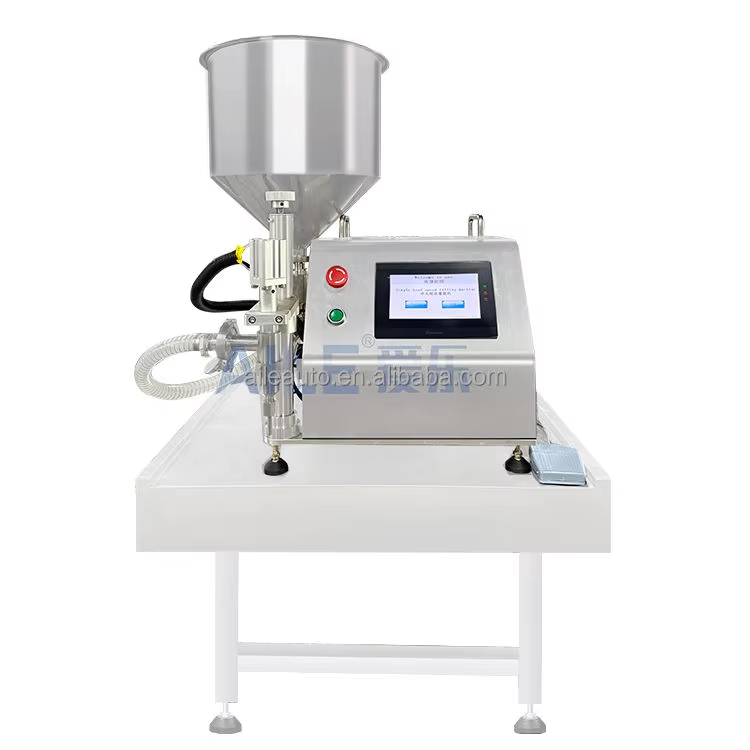
Achieving true batch consistency demands more than superior emulsification—it requires synchronized, closed-loop automation across the entire production line. Modern cosmetic filling machines integrate seamlessly with upstream mixing tanks and downstream packaging units (e.g., cappers, labelers) through shared PLC/HMI platforms. This architecture enables recipe-based control: exact temperature profiles, shear parameters, vacuum cycles, fill weights, and dwell times are stored, recalled, and replicated with sub-gram accuracy. Human intervention is minimized, reducing contamination risk and operator-induced variability. Crucially, the system maintains product integrity from emulsification through fill—preserving viscosity, droplet structure, and microbial quality. As verified by ISO 22716-compliant audits, such integrated lines consistently deliver <0.5% variation in fill weight and <1% deviation in viscosity across 10,000-unit batches—ensuring every container reflects the same high standard established at the first stage of processing.
FAQ Section
What is emulsification and why is it important in lotion manufacturing?
Emulsification is the process of mixing two immiscible liquids, like oil and water, to form a stable mix. It is crucial in lotion manufacturing to achieve uniform texture, stability, and enhance product quality.
Why is vacuum homogenization preferred in cosmetic manufacturing?
Vacuum homogenization removes entrapped air, prevents oxidation, foam formation, and stabilizes the emulsions. It enhances product texture, increases shelf life, and reduces the need for additional stabilizers.
What role does shear rate play in emulsification?
Shear rate affects droplet size distribution and the microstructure of emulsions. Controlled shear ensures uniform particle size, preserves sensitive actives, and improves long-term product stability.
How does temperature control improve lotion stability?
Temperature control reduces viscosity for effective mixing and prevents degradation of actives during processing. Controlled cooling locks in the emulsion matrix, ensuring long-term stability.
How do cosmetic filling machines contribute to batch consistency?
Cosmetic filling machines ensure precise filling, minimize contamination, and integrate seamlessly with upstream and downstream systems. They maintain uniformity in texture, weight, and appearance, ensuring consistent quality for each batch.
Table of Contents
- Precision Emulsification and Homogenization for Uniform Lotion Quality
- Ensuring Long-Term Emulsion Stability Through Integrated Processing Technology
- Protecting Active Ingredient Integrity During High-Performance Manufacturing
- End-to-End Batch Consistency via Seamless Integration with Cosmetic Filling Machine Systems
-
FAQ Section
- What is emulsification and why is it important in lotion manufacturing?
- Why is vacuum homogenization preferred in cosmetic manufacturing?
- What role does shear rate play in emulsification?
- How does temperature control improve lotion stability?
- How do cosmetic filling machines contribute to batch consistency?