
Understanding the Environmental Shift in Aerosol Packaging
The aerosol packaging industry is undergoing a significant transformation driven by tightening environmental regulations and growing consumer demand for sustainable products. Traditional aerosol cans rely on liquefied petroleum gas (LPG), hydrofluorocarbons (HFCs), or dimethyl ether (DME) as propellants, substances that contribute to volatile organic compound (VOC) emissions and carry flammability risks during both manufacturing and end use. A bag on valve filling machine offers a fundamentally different approach by separating the product from the propellant using an inner multi-layer bag, enabling manufacturers to replace hydrocarbon propellants with compressed air or nitrogen. This technology addresses multiple environmental concerns simultaneously: zero VOC emissions, elimination of flammable propellant handling in production facilities, and canisters that are easier to recycle since they contain no residual pressurized hydrocarbons. For cosmetic and personal care brands committed to sustainability targets, adopting BOV aerosol packaging represents a practical pathway to reducing their environmental footprint without sacrificing product performance.
How BOV Technology Eliminates VOC Emissions from Aerosol Products
The environmental advantage of a bag on valve filling machine starts at the product formulation level. In conventional aerosol systems, the propellant typically constitutes 25 to 40 percent of the total canister content and functions as both the dispensing force and a solvent for the active product. When the consumer sprays the product, propellant vapors are released into the atmosphere. HFC-based propellants, although now largely phased out under the Kigali Amendment to the Montreal Protocol, had global warming potential hundreds of times greater than carbon dioxide. Even LPG-based propellants, while having lower global warming potential, contribute to ground-level ozone formation through VOC emissions. A BOV system eliminates this entirely because the propellant is compressed air or nitrogen gas, both naturally occurring atmospheric gases. The product formulation also benefits environmentally because it no longer requires solvent adjustment to accommodate propellant mixing, allowing formulators to reduce or eliminate VOC solvents from the recipe.
Material Efficiency and Recyclability of BOV Packaging
Beyond propellant substitution, a bag on valve filling machine enables material efficiency improvements throughout the packaging lifecycle. Traditional aerosol cans require internal lacquer coatings to protect the metal from direct contact with the product-propellant mixture, adding material complexity that complicates recycling. BOV canisters, because the product never contacts the can wall, can use uncoated metal that is more readily recyclable through standard aluminum or steel recovery streams. The multi-layer bag inside the BOV canister adds a small amount of plastic material, but advanced bag designs now use mono-material polyethylene or reduced-thickness laminates that minimize plastic content. The canister itself can also be thinner and lighter than traditional aerosol cans because it does not need to withstand the internal pressure of liquefied propellant, reducing raw material consumption by an estimated 15 to 20 percent per can. These material savings compound across millions of units in high-volume cosmetic production.
Production Facility Benefits: Eliminating Explosion-Proof Infrastructure
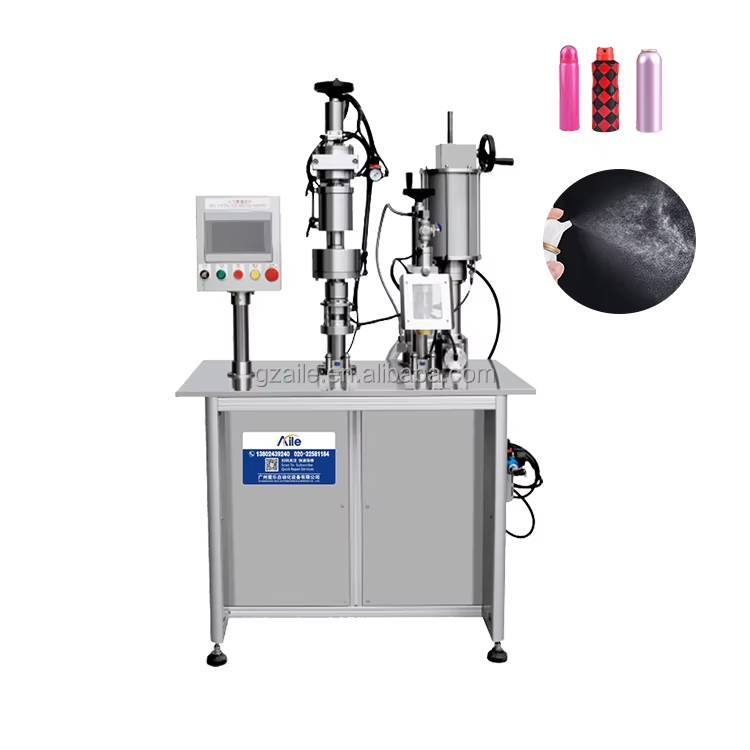
The operational benefits of a bag on valve filling machine extend into the production facility itself. Conventional aerosol filling lines that handle flammable propellants such as LPG or DME require explosion-proof electrical systems, gas detection and ventilation systems, fire suppression infrastructure, and compliance with ATEX in Europe or NFPA standards in North America. These requirements significantly increase facility construction and maintenance costs, and they restrict where the filling line can be located within the production site. A BOV filling line using non-flammable compressed air or nitrogen eliminates these requirements, allowing the filling equipment to be placed in standard production areas without special zoning. This flexibility reduces capital expenditure on the production facility and simplifies regulatory compliance. Manufacturers like Guangzhou Aile Automation Equipment supply BOV filling machines that operate with compressed air or nitrogen propellant, ISO 9001 certified and CE compliant, suitable for cosmetic manufacturers seeking to modernize their aerosol packaging with a lower-risk production environment.
Application Example: A Cosmetic Brand's Transition to Sustainable Aerosol Packaging
A European personal care brand producing aerosol body sprays in 150ml canisters faced escalating regulatory pressure to reduce VOC content in their products and increasing retailer requirements for sustainability credentials. Their conventional aerosol line used LPG as the propellant, which constituted approximately 30 percent of the can content by weight. The brand transitioned to a bag on valve filling machine production line with compressed air as the propellant, working with a BOV equipment supplier to adapt their body spray formulation for the new packaging system. The result was a 30 percent reduction in VOC content per unit, elimination of flammable propellant storage and handling on site, and a recyclable canister that could be marketed with an eco-friendly positioning statement. Consumer acceptance testing showed no negative impact on product performance, and the packaging was well received in markets with high environmental awareness. The transition required reformulating the product to perform without the solvent action of the propellant, but this reformulation effort ultimately yielded a product that could also be sold in pump-spray format using the same base formula, creating additional market flexibility.
Future Trends: BOV Technology in the Circular Economy Context
The role of bag on valve filling machines in sustainable packaging is likely to expand as regulatory and market pressures intensify. Several trends point toward increased BOV adoption. Extended producer responsibility (EPR) regulations in the European Union and other jurisdictions are placing greater financial liability on brands for packaging end-of-life management, making recyclable BOV canisters more economically attractive than multi-material traditional aerosol cans. Retailer sustainability scorecards increasingly penalize products with VOC-containing packaging formats, giving BOV-packaged products a competitive advantage on shelf. Technological improvements are also making BOV filling equipment more accessible to small and medium cosmetic brands, with semi-automatic systems available that require lower initial investment. The development of bio-based bag materials derived from renewable feedstocks rather than petroleum-based plastics is an emerging area that could further reduce the environmental footprint of BOV packaging, though these materials remain in early commercialization stages. Cosmetic brands evaluating long-term packaging strategy should consider BOV technology not as a niche option but as a forward-looking platform aligned with the trajectory of environmental regulation.
Technical Considerations When Implementing a BOV Packaging System
Before transitioning to a bag on valve filling machine, cosmetic manufacturers should evaluate several technical factors. Product formulation must be compatible with bag materials, typically laminated aluminum-polymer or multi-layer polyethylene, without causing delamination or permeation over the product shelf life. The product viscosity should be appropriate for injection through the valve stem, generally below 10,000 centipoise for standard BOV valves. Manufacturing teams must develop proficiency in bag quality inspection, as bag defects can cause product-propellant mixing that defeats the purpose of the BOV system. The canister crimping station requires precise setup because the bag-on-valve assembly seal must maintain integrity through the product's entire shelf life, often 24 to 36 months for cosmetic products. Suppliers with experience in BOV technology can provide the technical support and training needed to address these operational challenges, making supplier selection a critical step in the transition.
Frequently Asked Questions
How does a BOV filling machine make aerosol packaging more environmentally friendly?
A bag on valve filling machine replaces VOC-emitting hydrocarbon propellants with compressed air or nitrogen, eliminates the need for internal lacquer coatings in canisters, reduces can material weight by 15 to 20 percent, and produces packaging that is more easily recyclable through standard metal recovery channels.
Do BOV aerosol products perform the same as traditional aerosols?
Yes, BOV products deliver consistent spray patterns throughout the canister's life and can be used at any angle, including upside down. The spray discharge is silent compared to traditional aerosols. Consumer tests show equivalent or improved performance for most cosmetic spray applications including body sprays, sunscreens, and facial mists.
What is the cost difference between BOV and traditional aerosol packaging?
The per-unit packaging cost for BOV is typically 5 to 15 percent higher than traditional aerosol due to the multi-layer bag and specialized valve. However, the total cost of ownership often favors BOV when factoring in reduced regulatory compliance costs, elimination of explosion-proof facility requirements, lower insurance premiums for non-flammable production, and improved brand positioning in sustainability-conscious markets.
Table of Contents
- Understanding the Environmental Shift in Aerosol Packaging
- How BOV Technology Eliminates VOC Emissions from Aerosol Products
- Material Efficiency and Recyclability of BOV Packaging
- Production Facility Benefits: Eliminating Explosion-Proof Infrastructure
- Application Example: A Cosmetic Brand's Transition to Sustainable Aerosol Packaging
- Future Trends: BOV Technology in the Circular Economy Context
- Technical Considerations When Implementing a BOV Packaging System
- Frequently Asked Questions