
Why Bag-on-Valve Technology Transforms Fragrance and Skincare Spray Packaging
Perfume and skin spray manufacturers seeking to improve filling line efficiency increasingly turn to bag-on-valve (BOV) aerosol filling production systems. Unlike traditional aerosol packaging where propellant mixes directly with the product, a bag on valve filling machine uses a multi-layer bag inside the canister that separates the product from the propellant, typically compressed air or nitrogen. This separation delivers several production advantages: the product stays pure and uncontaminated by propellant, the spray pattern remains consistent from first to last use even at any angle, and the packaging operates silently without the pressurized gas escape noise of conventional aerosols. For fragrance brands, the BOV system also prevents propellant from altering the scent profile, a critical consideration when packaging luxury perfumes and premium skin mists. Production managers evaluating BOV lines find that the technology addresses both filling efficiency and end-user experience simultaneously.
The BOV Filling Production Line Workflow: From Bag Insertion to Final Inspection
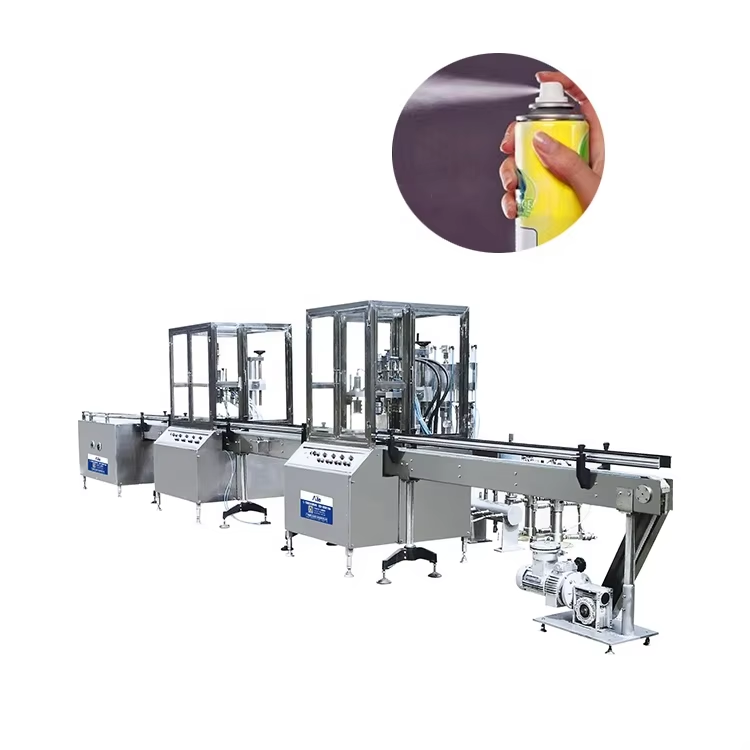
A complete bag on valve filling machine production line integrates multiple stations in a sequential workflow. The process begins with bag insertion, where the multi-layer laminated bag is fed into empty canisters either manually in semi-automatic systems or via automatic bag insertion modules in fully automated lines. The canister then moves to the valve crimping station, where the bag-on-valve assembly is sealed into the canister opening. Next is the product filling station, where the cosmetic formulation is injected through the valve stem into the bag using a metered filling system that controls both volume and injection pressure to avoid bag damage. After product filling, the canister proceeds to the gassing station where compressed air or nitrogen is injected into the space between the bag and the canister wall, typically at 8 to 12 bar pressure. Finally, the filled canister passes through a hot water bath test at 55 degrees Celsius to verify pressure integrity, followed by actuator placement and cap fitting. A well-designed BOV production line processes 30 to 60 cans per minute depending on automation level and canister size.
Key Efficiency Drivers in Modern BOV Aerosol Filling Lines
Production efficiency gains in a bag on valve filling machine stem from several technical optimizations. Multi-station rotary filling platforms allow simultaneous operations, with product filling, gassing, and inspection occurring on different stations around a central rotary table rather than in a linear sequence that creates wait time at each step. Servo-driven metering pumps replace pneumatic timers, improving fill accuracy from a typical plus or minus 3 percent to within plus or minus 0.5 percent and eliminating the need for post-fill weight checks that slow production. Automated bag insertion systems reduce manual handling time, with vision-guided robotic arms placing pre-formed bags into canisters at speeds matching the downstream filling rate. Quick changeover features, including tool-free canister guide adjustments and recipe-based parameter storage, allow operators to switch between 30ml, 50ml, and 100ml canister sizes in under 15 minutes. These optimizations collectively enable a modern BOV line to achieve output rates that would require two or three older-generation systems.
Preserving Fragrance Integrity Through Contact-Free Filling
Perfume and skin spray manufacturers have a unique requirement that conventional aerosol filling cannot meet: product purity. In a traditional aerosol, the propellant solvent mixes with the fragrance or skincare formulation, which can alter the scent profile through chemical interaction or dilute the active ingredient concentration. A bag on valve filling machine keeps the product inside a sealed multi-layer bag that acts as a physical barrier between the product and the propellant. The filling process injects the product through the valve stem directly into the bag, and the propellant is then charged into the space outside the bag. This configuration also means the canister material never contacts the product, allowing the use of standard tinplate or aluminum canisters without internal lacquer coatings that might react with fragrance compounds. For organic or natural skincare spray brands that avoid propellant solvents, BOV packaging enables compressed air or nitrogen as clean propellant alternatives.
Application Example: Luxury Perfume Brand Transitions to BOV Spray Packaging
A luxury perfume brand producing 30ml spray-format fragrances faced market feedback that the traditional aluminum aerosol packaging used for their travel-size products did not match the premium brand positioning. Customers noted that the scent was slightly altered compared to the glass bottle format, and the packaging noise during use was inconsistent with a luxury experience. The brand switched to a bag on valve filling machine production line using 30ml aluminum canisters with nitrogen as the propellant. The fragrance product, formulated identically to the glass bottle version, delivered an unchanged scent profile because the propellant never contacted the liquid. The silent spray discharge, consistent spray pattern throughout the canister's life, and the ability to spray at any angle improved the user experience rating in consumer tests by a measurable margin. Production efficiency also improved because the BOV line eliminated the need for cold filling or pressure filling processes that the previous aerosol line required, reducing per-unit processing time.
Evaluating BOV Filling Line Specifications for Perfume and Skincare
When sourcing a bag on valve filling machine for fragrance or skin spray production, buyers should evaluate several technical specifications. The machine's valve compatibility is critical, as BOV valves come in 1-inch and 20mm standard sizes with various stem configurations. The filling system should include a vacuum crimping station that removes air from the canister before valve sealing to prevent bag oxidation. Product filling pressure must be adjustable from 2 to 12 bar to accommodate different formulation viscosities without damaging the bag material. The gassing station should offer both compressed air and nitrogen compatibility, with integrated pressure monitoring to ensure consistent propellant charge. Guangzhou Aile Automation Equipment manufactures BOV filling machines with these features, supported by ISO 9001 quality management certification and CE compliance for export markets. Buyers should also verify that the supplier provides training on bag handling, valve crimping setup, and pressure testing procedures, as these operational aspects directly affect line efficiency.
Return on Investment Analysis for BOV Line Implementation
A bag on valve filling production line represents a higher capital investment than a basic liquid filling machine, but the unit economics justify the cost for brands targeting premium segments. The primary cost advantage comes from reduced product waste. In conventional aerosol filling, overfill is common because some product is lost during valve purge and pressure equalization. BOV filling achieves fill accuracy within plus or minus 0.5 grams, virtually eliminating overfill for high-value fragrance products where every gram of product cost is significant. Secondary savings come from simplified logistics: BOV canisters can be filled at ambient temperature without the refrigerated cold-fill process required for some conventional aerosol formulations, reducing energy costs and eliminating the explosion-proof infrastructure typically required for hydrocarbon propellant handling. For a brand producing 500,000 perfume spray units annually at a product cost of 15 dollars per unit, reducing overfill by 1 gram per unit saves 7,500 dollars in product value and reduces shipping weight by 500 kilograms.
Frequently Asked Questions
What is the difference between a BOV aerosol filling machine and a conventional aerosol filler?
A bag on valve filling machine uses a multi-layer bag to separate product from propellant, filling the product into the bag through the valve stem and then charging compressed air or nitrogen around the bag. Conventional aerosol fillers mix propellant gas directly with the product. BOV systems offer purer product delivery, silent spray, 360-degree spraying, and no propellant-product interaction.
Can a BOV line handle both perfume and skincare spray products?
Yes, a BOV production line with recipe-based controls can handle different formulations including perfumes, facial mists, body sprays, and sunscreens. Operators switch between products by selecting saved recipes that adjust fill volume, injection pressure, and gassing parameters. Valve and canister size changeover takes under 15 minutes on modern systems.
What propellant options are available for BOV cosmetic packaging?
Bag on valve filling machines typically use compressed air or nitrogen as propellants, both of which are clean, non-flammable, and environmentally neutral. Some BOV systems can also use compressed CO2, though nitrogen is preferred for oxygen-sensitive formulations because it provides an inert atmosphere inside the canister.
Table of Contents
- Why Bag-on-Valve Technology Transforms Fragrance and Skincare Spray Packaging
- The BOV Filling Production Line Workflow: From Bag Insertion to Final Inspection
- Key Efficiency Drivers in Modern BOV Aerosol Filling Lines
- Preserving Fragrance Integrity Through Contact-Free Filling
- Application Example: Luxury Perfume Brand Transitions to BOV Spray Packaging
- Evaluating BOV Filling Line Specifications for Perfume and Skincare
- Return on Investment Analysis for BOV Line Implementation
- Frequently Asked Questions