Choosing an aerosol filling machine should start with your actual product and production requirements — not simply with the highest available machine speed.
Two factories producing aerosol products may need completely different equipment even if their target output is similar. Product viscosity, filling volume, can size, valve specification, propellant, required automation level and workshop layout can all affect the final machine configuration.
For most aerosol production projects, equipment selection should begin with these questions:
- What product will be filled?
- What production capacity is required?
- What are the aerosol can and valve specifications?
- Which propellant will be used?
- Is semi-automatic or automatic production more suitable?
- How much workshop space is available?
- Will more SKUs or downstream equipment be added later?
A well-matched machine should meet current production requirements without creating unnecessary complexity or limiting future expansion.
1. Start With the Aerosol Product
The first step is to define exactly what you plan to produce.
Different aerosol applications can require different filling methods, product-contact materials, mixing requirements, propellant systems and downstream equipment.
Typical applications include:
- Lubricant and penetrating oil aerosol
- Hairspray
- Deodorant and body spray
- Household insecticide
- Shaving foam
- Spray paint
- Air freshener
- Bag-on-Valve products
- Metered Dose Inhalers (MDI)
For example, lubricant aerosols may range from relatively free-flowing penetrating oils to formulations containing additional additives.
Spray paint production may require continuous product mixing and additional equipment such as automatic glass ball feeding.
Shaving foam and other higher-viscosity products may also require a different liquid filling configuration from low-viscosity body sprays or air fresheners.
Bag-on-Valve production requires dedicated BOV filling equipment because the product and propellant are separated by the internal bag.
For BOV applications, see our Bag-on-Valve filling machine.
The physical characteristics of the formulation should therefore be confirmed before the machine model is selected.
For unusual products, providing the actual material or a video showing its flow characteristics can help confirm the filling method before production.
2. Determine the Required Production Capacity
Production capacity determines much more than machine speed.
It affects the automation level, number of stations, operator involvement, workshop layout and overall production workflow.
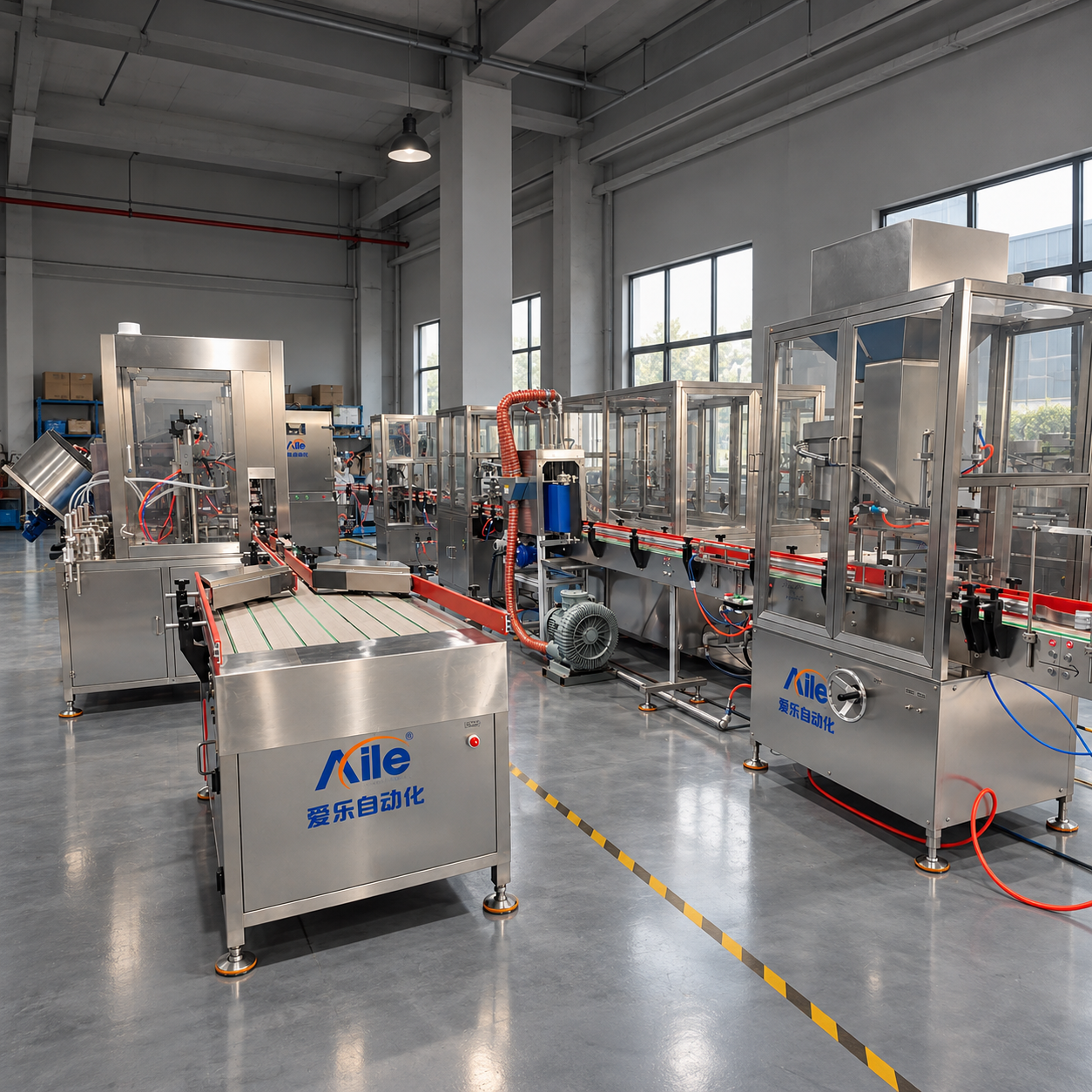
AILE commonly provides three production levels:
| Production Level | Typical Capacity | Typical Use |
|---|---|---|
| Semi-Automatic | 500–700 cans/hour | Small batches, multiple SKUs, flexible production and new aerosol projects |
| Standard Automatic | 2,400–3,600 cans/hour | Stable commercial production and regular daily orders |
| High-Speed Automatic | 4,800–7,200 cans/hour | Large-volume continuous production |
Semi-Automatic Production
Semi-automatic equipment is generally more suitable when:
- Batch sizes are relatively small
- Several products are manufactured on the same equipment
- Product changeovers are frequent
- Production demand is still developing
- Flexibility is more important than maximum output
For example, one AILE semi-automatic aerosol filling configuration operates at approximately 500–700 cans/hour, with a working air pressure of 0.6–0.8 MPa and air consumption of approximately 0.6 m³/min.
The exact machine specification depends on the selected model.
Explore our semi-automatic aerosol filling machine for flexible production options.
Standard Automatic Production
For factories with stable commercial orders, a standard automatic filling line provides a better balance between capacity, automation and investment.
AILE standard automatic aerosol filling lines typically operate at approximately 2,400–3,600 cans/hour.
A complete production line can integrate:
- Can conveying
- Liquid filling
- Valve placing
- Valve crimping
- Propellant filling
Optional downstream equipment can then be added according to the production process.
High-Speed Production
High-speed lines are more suitable when:
- Large orders are produced continuously
- Output is the main production priority
- Main SKUs are relatively stable
- Manual handling must be reduced further
- The factory is planning long-term capacity expansion
AILE high-speed aerosol production lines can be configured for approximately 4,800–7,200 cans/hour.
For high-output projects, individual filling modules may operate at higher speeds. For example, AILE's high-speed liquid filling module can reach approximately 100–120 cans/minute under suitable conditions.
However, this module speed should not be interpreted as the guaranteed output of the complete line.
Final production speed depends on all stations in the production process.
The fastest machine is therefore not automatically the best choice. The correct production level should match the actual order volume, SKU mix and production plan.
3. Confirm the Aerosol Can, Valve and Filling Volume
Packaging specifications should be confirmed before machine configuration.
Manufacturers should provide:
- Aerosol can diameter
- Aerosol can height
- Liquid filling volume
- Propellant filling volume
- Valve specification
- Actuator or spray button
- Cap or other accessories
Machine ranges vary according to the selected model.
For example, one AILE standard automatic aerosol line is designed for cans approximately:
- Diameter: 35–70 mm
- Height: 80–300 mm
Many standard aerosol projects use a 1-inch (25.4 mm) aerosol valve, while special specifications can be customized according to the project.
Providing actual cans, valves and other packaging materials before machine delivery is strongly recommended.
AILE commonly asks customers to send representative packaging samples for machine setup and testing before shipment. This allows the production team to confirm compatibility and also reduces the risk that the customer receives the machine without the correct initial settings.
4. Choose the Correct Propellant Filling System
Propellant selection directly affects the gas filling method, required pressure system and safety configuration.
AILE aerosol filling equipment can be configured for common propellants including:
- LPG
- DME
- Nitrogen (N₂)
- Carbon dioxide (CO₂)
Flammable propellants such as LPG and DME require appropriate explosion-proof production considerations.
Depending on the machine and project configuration, AILE can provide explosion-proof equipment configurations, and explosion-proof certification is available for applicable equipment.
AILE also provides CE-certified aerosol filling equipment.
For projects requiring dedicated propellant filling, see our aerosol propellant filling machine.
The propellant should always be confirmed before the gas filling system is finalized.
Do not select gas filling equipment only according to nominal filling volume. The propellant type, required filling amount and production process should be evaluated together.
5. Decide Between Individual Machines and a Complete Filling Line
Another important decision is whether you need individual filling machines or a complete production line.
Individual and Semi-Automatic Machines
For smaller or more flexible production, equipment may be configured as individual stations or integrated semi-automatic machines.
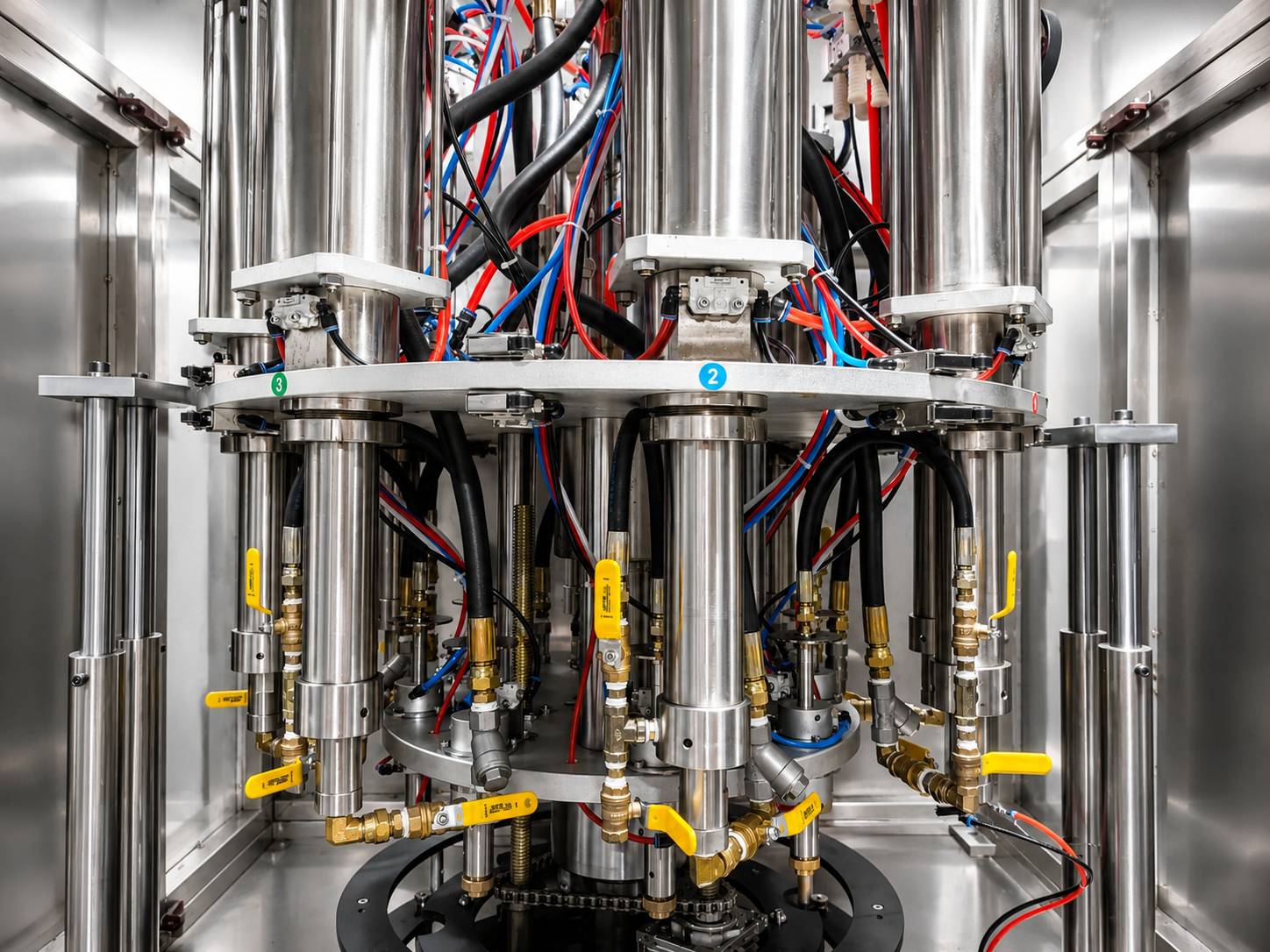
Typical equipment includes:
- Liquid filling machine
- Valve placing machine
- Valve crimping machine
- Propellant filling machine
- Integrated semi-automatic filling systems
These configurations are generally easier to use for small batches and frequent production changes.
Explore AILE's complete range of aerosol filling machines.
Complete Automatic Aerosol Filling Lines
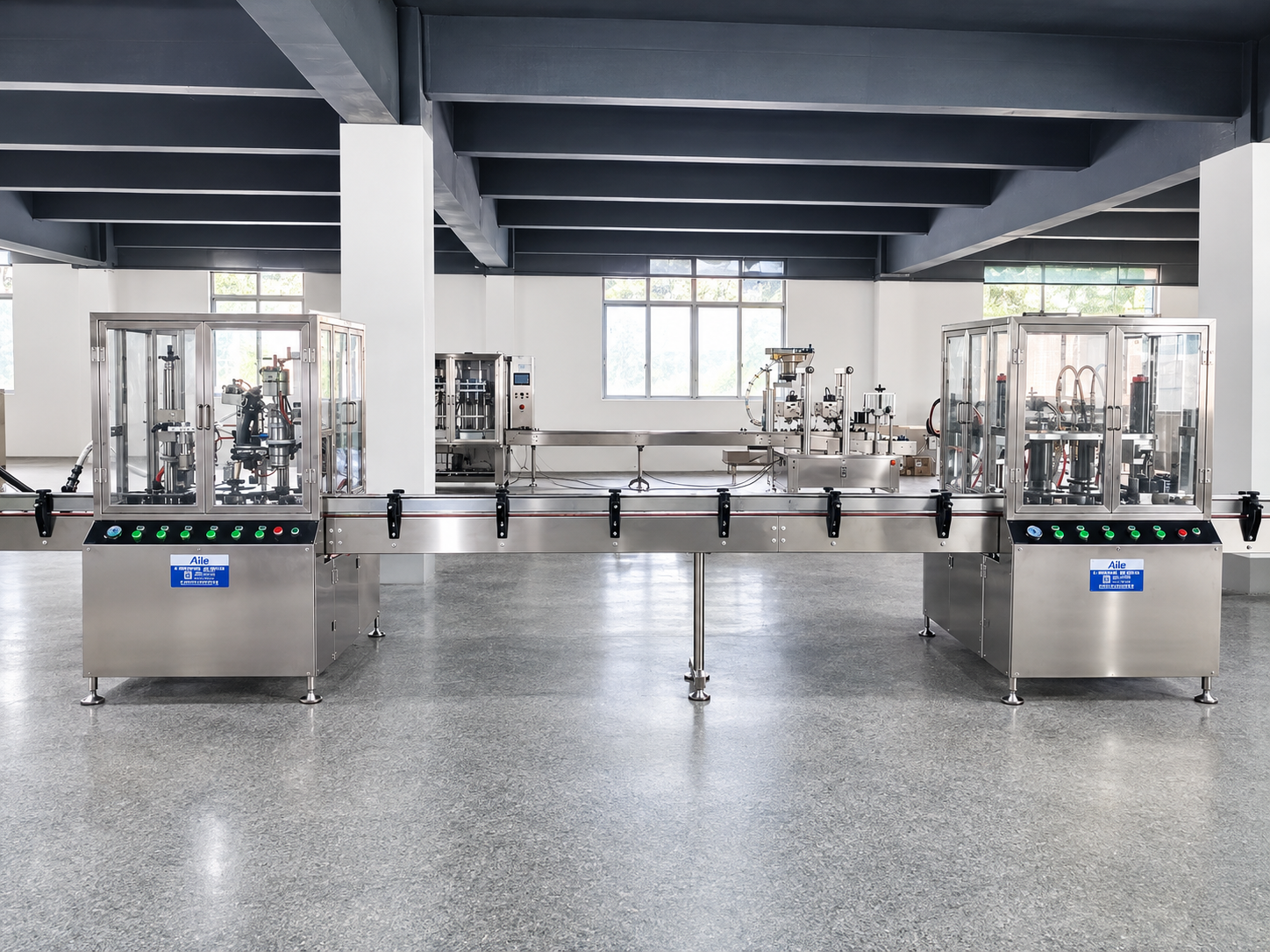
For continuous commercial production, a complete line connects the major production stages into one workflow.
A typical automatic line can include:
- Can conveying
- Liquid filling
- Valve placing
- Valve crimping
- Propellant filling
Depending on the customer's production requirements, optional downstream equipment can also be integrated, including:
- Water bath leakage testing
- Online checkweighing
- Actuator pressing
- Cap pressing
- Coding
- Extension straw application
- Conveyor systems
- Packing equipment
These downstream machines are selected according to the actual project and are not necessarily included in every line.
For integrated production systems, explore our aerosol filling lines.
6. Consider Filling Accuracy and Product Consistency
Machine speed should not be evaluated independently from filling accuracy.
Different filling systems have different accuracy requirements depending on the filling volume and product.
For example, one AILE semi-automatic aerosol filling system has a filling accuracy of approximately ≤ ±1 g.
AILE high-speed liquid filling modules use different accuracy specifications depending on the filling volume:
- Up to 100 ml: approximately ±0.5 ml
- Up to 200 ml: approximately ±1 ml
- Up to 300 ml: approximately ±1.5 ml
The applicable accuracy should always be confirmed according to the selected machine and actual filling volume.
For buyers, the important question is therefore not simply: How fast can the machine run? It is also: Can it maintain the required filling consistency at my actual filling volume?
This should be verified during machine testing before shipment.
7. Consider Workshop Space and Line Layout
Factory layout should be discussed before the complete line is finalized.
A complete aerosol filling line arranged in a straight layout may have a total length of approximately 21 meters, depending on the selected equipment.
However, the line does not always need to be installed in one straight row.
AILE can design:
- Straight layouts
- U-shaped layouts
- L-shaped layouts
This allows the equipment to better fit the customer's existing workshop.
For a complete aerosol filling project, a workshop area of approximately 100 m² or more is generally recommended.
The exact requirement depends on:
- Final equipment configuration
- Auxiliary equipment
- Operating and maintenance space
- Material handling areas
- Propellant handling requirements
- Workshop shape
This does not mean that the machine itself occupies 100 m². The recommended area includes the operating environment required around the complete production system.
Providing a workshop floor plan before machine design allows the line layout to be adjusted around the actual factory instead of forcing the factory to adapt to a fixed straight-line arrangement.
8. Consider Safety and Explosion-Proof Requirements
Aerosol production involves pressurized containers and, in many projects, flammable propellants.
Safety requirements should therefore be considered at the beginning of equipment selection rather than added after the machine has already been designed.
Important factors include:
- Propellant type
- Gas filling method
- Production area ventilation
- Equipment safety configuration
- Applicable local factory requirements
- Electrical and pneumatic configuration
- Propellant handling and storage arrangement
For projects using LPG, DME or other flammable propellants, the final equipment and workshop configuration should be reviewed according to the destination country's applicable safety requirements.
AILE can provide CE-certified machines and explosion-proof certified configurations for applicable aerosol filling equipment.
Buyers should provide the destination country and any required local certification standards before the final equipment proposal is confirmed.
9. Think About Future Production Requirements
Equipment should not be selected only for today's orders.
Before purchasing, consider whether:
- Production volume may increase
- Additional SKUs may be introduced
- Different aerosol can sizes may be added
- Leak testing may be required later
- Checkweighing may be added
- Automatic actuator or cap pressing may be added
- Packing automation may become necessary
The most suitable machine is not necessarily the fastest line available. It should provide enough capacity for current production while leaving reasonable room for future development.
Future expansion possibilities depend on the original machine configuration, so they should be discussed before the equipment is finalized.
10. Quick Aerosol Filling Machine Selection Guide
| Your Production Situation | Recommended Direction |
|---|---|
| Small batches, frequent SKU changes or early-stage production | Semi-automatic aerosol filling equipment |
| Stable commercial production | Standard automatic aerosol filling line |
| Large and continuous production volume | High-speed automatic aerosol filling line |
| Product needs to remain separated from propellant | Dedicated Bag-on-Valve filling equipment |
| MDI or specialized pharmaceutical aerosol production | Dedicated MDI filling equipment |
| Spray paint or formulations requiring continuous mixing | Customized aerosol line with suitable mixing and auxiliary equipment |
| Limited workshop length | U-shaped or L-shaped production line layout |
This table is intended as a starting point. The final equipment configuration should always be based on the real product, packaging materials and production target.
11. What Information Should You Send Before Equipment Selection?
A useful machine recommendation requires more than simply asking for a price.
Before requesting a proposal, prepare:
- Product name and application
- Basic formulation information
- Approximate viscosity or product flow characteristics
- Aerosol can diameter and height
- Liquid filling volume
- Propellant filling volume
- Valve specification
- Actuator and cap details
- Propellant type
- Target production capacity
- Number of SKUs
- Workshop dimensions
- Required automation level
- Destination country
- Required voltage and frequency
For special formulations, AILE may also ask customers to provide:
- Product samples
- Aerosol cans
- Valves
- Actuators
- Caps
- Other packaging materials
These materials can be used for machine setup and factory testing before shipment.
12. Frequently Asked Questions
Can one aerosol filling machine be used for different products?
In many cases, yes. The key question is whether the different products fall within the machine's applicable filling range and whether the product-contact configuration is suitable for each formulation. If several products will be produced on the same equipment, provide all formulas or basic material information during machine selection. AILE can then evaluate whether the products can share the same filling system or whether certain product-contact parts or settings should be changed.
Can the same line handle different aerosol can sizes?
Many AILE aerosol machines can be adjusted or customized for different can sizes within the machine's applicable range. Before confirming the machine, provide the diameter and height of every aerosol can size you plan to use. For projects involving multiple packaging formats, it is also recommended to send representative cans, valves and actuators for factory setup and testing.
What aerosol valve specifications can AILE equipment handle?
Many standard aerosol projects use 1-inch (25.4 mm) valves. For example, one AILE semi-automatic aerosol filling configuration uses a 25.4 mm valve, with a typical sealing diameter of approximately 27.1–27.3 mm and sealing depth of approximately 5.0–5.2 mm. These figures are machine-specific and should not be treated as universal specifications for every AILE model. Special valve specifications can be evaluated according to the project.
Which propellants can AILE equipment handle?
AILE aerosol filling equipment can be configured for common propellants including: LPG, DME, N₂, and CO₂. The correct gas filling configuration depends on the propellant, filling amount and required production process.
Does AILE provide explosion-proof aerosol filling equipment?
Yes. Explosion-proof configurations and related certification are available for applicable aerosol filling equipment. The required configuration should be confirmed according to the propellant, production process and destination country's requirements.
How much workshop space do I need for an automatic aerosol filling line?
A complete straight aerosol filling line can be approximately 21 meters long, depending on the configuration. For complete projects, approximately 100 m² or more of workshop area is generally recommended. If straight-line space is limited, AILE can also design U-shaped or L-shaped layouts to use the available floor area more efficiently.
Should I choose semi-automatic or fully automatic equipment?
Choose semi-automatic equipment when production flexibility, smaller batches or frequent SKU changes are more important than maximum output. Choose an automatic line when production is stable and reducing manual handling becomes more important. For large continuous production volumes, a high-speed line may be more suitable. The decision should be based on your actual capacity requirement rather than simply selecting the fastest available machine.
13. Plan Your Aerosol Filling Project With AILE
Choosing an aerosol filling machine should involve more than comparing machine prices and nominal speeds.
A suitable production solution should match:
- Your actual formulation
- Packaging materials
- Propellant
- Production capacity
- Factory layout
- Automation requirements
- Future expansion plans
AILE can help evaluate these factors before the final machine configuration is confirmed.
For project evaluation, you can send us: product information, can dimensions, filling volumes, valve and actuator samples, propellant type, target capacity, and workshop drawings.
Customers can also send actual packaging materials and special product samples to AILE for machine testing before shipment.
For complete production projects, AILE can also design the line layout according to the available factory space, including straight, U-shaped and L-shaped configurations.
Send your product, packaging and production requirements to AILE to receive a machine configuration and technical proposal for your aerosol production project.