
Aerosol manufacturing equipment encompasses the specialized machinery used to fill liquid product, insert and crimp valves, inject propellant gas, and test pressurized aerosol cans. A complete production line integrates these steps with automated quality control and packaging systems to ensure safe, compliant, and efficient manufacturing.
When upgrading an existing facility or building a new plant, selecting the right aerosol filling equipment is critical. The wrong configuration can lead to bottlenecks, safety hazards with propellants, or inefficient changeovers. With over 20 years of industry expertise at AILE Automation, and having exported CE-certified, explosion-proof aerosol equipment to over 60 countries, we have helped countless plant managers navigate these exact challenges.
This guide breaks down the core components, capacity considerations, and safety requirements to help you configure the ideal aerosol production line.
Core Components of a Complete Aerosol Production Line
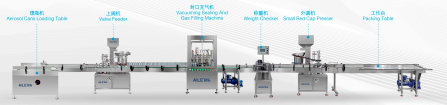
A standard automated setup moves empty cans through a series of synchronized stations. Depending on your needs, you can explore our complete Automatic Aerosol Filling Line solutions.

Liquid Filling, Valve Insertion, and Crimping
The process begins with the aerosol cans loading table feeding containers into the liquid filling machine. For hygiene and durability, especially when handling cosmetics or corrosive industrial chemicals, all product-contact parts must be constructed from SS316 or SS316L stainless steel. Following the liquid fill, the valve sealing machine (crimper) secures the 1-inch valve, creating an airtight seal crucial for the subsequent pressurization.
Propellant Gas Filling: The Most Critical Step
Injecting the propellant requires absolute precision to ensure the correct internal pressure and spray pattern. Our gas filling machines utilize advanced PLC and HMI controls alongside high-quality pneumatic components to maintain consistent dosing, whether you are filling 10ml or 300ml of gas per can.
Quality Control & Safety Testing
Safety compliance cannot be compromised in aerosol manufacturing.
- Water Bath Leak Testing Machine: Submerges pressurized cans in warm water to detect micro-leaks via escaping bubbles.
- Weight Checking Machine: Automatically weighs each can, rejecting any that fall outside the specified tolerance to guarantee consumer safety and product consistency.
End-of-Line Packaging
Once cans pass inspection, they move to the end-of-line stations. The nozzle/actuator presser and outer cover/cap presser automate the finishing touches. Finally, a date printer applies batch codes before the products reach the packing table.
How to Choose Equipment Based on Production Capacity
Selecting the right equipment hinges on your target bottles per hour (BPH). Over-investing wastes capital, while under-investing bottlenecks your growth.
| Automation Level | Target Capacity (BPH) | Ideal Applications | Budget/Footprint |
|---|---|---|---|
| Semi-Automatic | Custom / Low | Lab testing, startups, small-batch cosmetics | Low budget, compact |
| Standard Automatic | 2400 - 3600 | Air fresheners, standard spray paints, PU foam | Medium footprint, linear setup |
| High-Speed Automatic | 4800 - 7200 | Large-scale manufacturing, high-demand FMCG | Custom U-shape or L-shape layout |

Semi-Automatic Systems
For investors just entering the market or R&D labs testing new formulations, a Semi-Automatic Aerosol Filling Machine is the most practical choice. It requires manual can handling between the filling, crimping, and gassing stations but offers high flexibility for frequent product changeovers.
Standard Automatic Lines (2400-3600 BPH)
Designed for mid-sized operations, our standard linear production lines handle 2400 to 3600 cans per hour. Operating at a working pressure of 0.7-0.8Mpa, this setup is perfect for standard 1-inch valves and aluminum or tinplate cans. We recently deployed a similar configuration for a highly successful automated spray paint line in Australia, proving its reliability under continuous operation.
High-Speed Automatic Lines (4800-7200 BPH)
When scaling up to massive retail distribution, high-speed lines deliver 4800 to 7200 BPH. Because factory space is often a constraint, these robust SS304 frame systems feature customized layouts (straight, U-shaped, or L-shaped) tailored to your facility's exact dimensions.
The Impact of Propellants on Equipment Configuration
Your choice of propellant dictates the safety engineering of your aerosol production equipment.
Flammable Propellants (LPG, DME)
Handling liquefied petroleum gas (LPG) or dimethyl ether (DME) requires stringent safety measures. Equipment must be entirely explosion-proof (Ex-proof). At AILE, we utilize fully pneumatic systems in hazardous zones and explosion-proof motors where electricity is required. Facilities must also adhere to strict ventilation and safety standards, such as those outlined by the NFPA guidelines for aerosol manufacturing facilities.
Compressed Gases (N₂, CO₂)
Non-flammable compressed gases require different handling. Because they operate at higher pressures and do not liquefy in the can like LPG, the gas filling stations require heavy-duty, high-pressure seals and robust crimping mechanisms to prevent immediate or gradual pressure loss.
Standard Aerosol vs. BOV and MDI Systems
Understanding your specific product application is essential, as specialized aerosols require distinct machinery.
Traditional Aerosol Packaging
This is the standard one-valve system used for everything from lubricants to hairspray, where the product and propellant are mixed inside the can.
Bag-on-Valve (BOV) Filling Lines
For products that must remain separate from the propellant (like nasal sprays, olive oil, or sunscreen), BOV is required. Our Bag-on-Valve Filling Machine lines support capacities from 1500 to 4200 BPH. In this process, the propellant (compressed air or N₂) is injected into the can before the liquid is forced into the inner bag, requiring specialized under-the-cup gassing and crimping technology.
MDI (Metered-Dose Inhalers) Equipment
Pharmaceutical aerosols demand the highest sanitary and precision standards. Drawing on our experience exporting specialized MDI equipment to the United States, these machines feature ultra-precise micro-dosing valves, sanitary 316L stainless steel, and strict cleanroom compliance.
Expert Advice: What to Prepare Before Requesting a Quote
To get the most accurate layout and quote from a manufacturer, prepare the following specifications beforehand:
- Can dimensions: Material (aluminum/tinplate), diameter (e.g., Φ35-73mm), and height (e.g., 80-330mm).
- Valve specifications: Typically 1-inch, but variations exist for specific applications.
- Liquid properties: Viscosity, foaming characteristics, and corrosiveness.
- Propellant type: LPG, DME, N₂, CO₂, or compressed air.
- Target BPH: Your required output per hour to determine the automation level.
Maintenance, Changeovers, and Future Expansion
A well-designed aerosol filling line should adapt to your business. Look for modular equipment that allows for easy integration of additional filling heads as demand grows. For factories producing multiple SKUs, fast changeover is vital. Quick-release guide rails and easily adjustable height mechanisms on our capping and filling stations minimize downtime when switching between different can sizes. Furthermore, integrated CIP (Clean-in-Place) compatibility ensures thorough pipeline cleaning when transitioning between different liquid formulations.
Frequently Asked Questions (FAQ)
Is a water bath leak tester strictly required for aerosol production?
Yes. To ensure consumer safety and comply with international transport regulations (such as DOT and ADR requirements for aerosol packaging), all pressurized cans containing flammable propellants must pass a hot water bath test to verify seal integrity before leaving the facility.
Can I use the same machine for different aerosol products (e.g., spray paint and cosmetics)?
While technically possible if the can sizes and valves are similar, it is highly discouraged. Cross-contamination between industrial chemicals (paint) and personal care items (cosmetics) poses severe health risks. The extensive cleaning required for safe changeovers makes it economically impractical. We recommend separate lines for distinctly different product categories.
What is the typical lead time for a customized aerosol filling line?
Lead times vary based on automation complexity. A semi-automatic machine may be ready in 15-30 days, while a fully automated, customized high-speed line typically requires 60 to 90 days for engineering, manufacturing, and comprehensive factory acceptance testing (FAT).
Ready to upgrade your production capacity?
Contact / Request a Customized Solution