
Addressing Efficiency Challenges in Body Spray Production
Body spray manufacturers in the cosmetic industry face a unique set of production challenges. These products typically combine alcohol-based or water-based formulations with fragrance oils, requiring filling equipment that can handle volatile solvents without degradation while delivering precise fill volumes across large production batches. The market for body sprays continues to grow, driven by consumer demand for affordable daily-use fragrance products, yet many mid-sized manufacturers still rely on labor-intensive manual filling processes that limit output and introduce quality variability. A manual filling machine with semi-automatic control specifically configured for body spray applications addresses these efficiency constraints by automating the critical dosing and sealing steps while maintaining the operational flexibility that cosmetic manufacturers need when producing multiple fragrance variants in shorter production runs.
How Semi-Automatic Filling Machines Optimize Body Spray Production Workflow
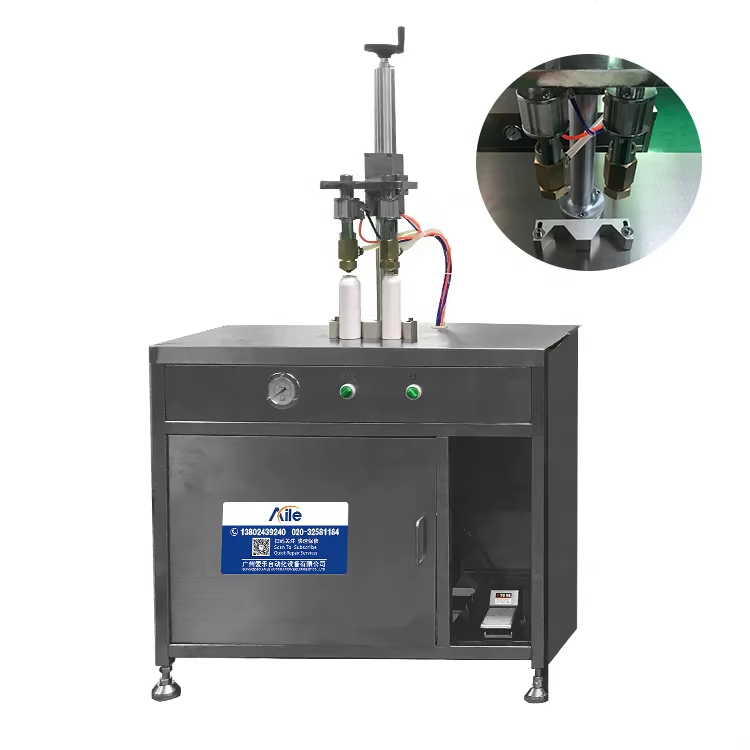
The efficiency gains from a semi-automatic manual filling machine in body spray production stem from its ability to handle the three most time-consuming and quality-critical steps with consistent precision: liquid filling, valve placement, and crimping. In a manual operation, each of these steps requires operator judgment and physical effort that varies between operators, between shifts, and even throughout an individual operator's workday as fatigue sets in. A semi-automatic system replaces operator judgment with pneumatic or servo-driven controls for the filling volume and crimping force, while still allowing the operator to load and unload cans and initiate each cycle. This division of labor between operator and machine results in a cycle time of approximately 10 to 15 seconds per can, translating to 240 to 360 cans per hour with a single operator compared to 100 to 150 cans per hour in a fully manual setup. The improved consistency in fill volume and crimp quality reduces rework and rejection rates from a typical 5 to 8 percent under manual operation to below 2 percent.
Material Compatibility for Alcohol-Based and Water-Based Body Sprays
Body spray formulations vary significantly in their chemical composition, and the filling equipment must be compatible with both alcohol-based and water-based products. Alcohol-based body sprays, which typically contain 60 to 80 percent ethanol or denatured alcohol, require filling machine components with excellent solvent resistance. Product-contact parts including the filling nozzle, metering cylinder, and seals should be constructed from 316L stainless steel with PTFE or FFKM (perfluoroelastomer) seals, as standard EPDM or nitrile seals will degrade upon prolonged alcohol exposure and may leach compounds into the product. For water-based body sprays, material compatibility is less demanding, but the filling system must include effective anti-drip and suck-back features to prevent water-based formulations from dripping onto the can exterior, which can cause labeling adhesion problems downstream. A well-designed manual filling machine for body spray applications should offer interchangeable seal kits that allow the same machine to be configured for alcohol-based or water-based production with a changeover time of under 30 minutes.
Production Planning for Multi-Fragrance Body Spray Manufacturing
Cosmetic manufacturers producing body sprays typically manage a portfolio of 5 to 15 fragrance variants, each requiring separate production runs with cleaning between batches to prevent fragrance cross-contamination. The efficiency of a manual filling machine in this multi-product environment depends heavily on its cleanability and changeover speed. Machines designed with quick-disconnect filling heads, removable product reservoirs, and minimal dead-leg piping allow operators to complete a full product changeover, including flushing the system with cleaning solvent and verifying cleanliness, in 20 to 40 minutes. This compares favorably to the 60 to 90 minutes typically required to clean a fully automatic rotary filling system, making semi-automatic equipment particularly well-suited to the short production runs common in the fragrance body spray segment. Production scheduling efficiency improves further when the machine's recipe management system stores filling parameters for each fragrance variant, eliminating the need for manual recalibration.
Quality Assurance in Semi-Automatic Body Spray Filling
Quality assurance for body spray filling extends beyond fill volume accuracy to include can integrity, valve function, and propellant charge verification. A semi-automatic manual filling machine contributes to quality consistency by standardizing the crimping dimension, which is the most common source of aerosol can leakage. The crimp specification for a standard one-inch aerosol valve typically requires collet crimp diameter and crimp height to fall within a tolerance band of plus or minus 0.05mm, achievable with a machine-controlled pneumatic or servo crimping head but extremely difficult to maintain with manual crimping tools over an entire production shift. After filling and crimping, each can should undergo a hot water bath test at 50 to 55 degrees Celsius to detect slow leaks, with statistical sampling protocols defined based on production volume and product criticality. The filling machine's contribution to quality begins with precise liquid dosing and proper valve seating, creating the conditions for successful downstream quality verification.
Cost-Benefit Analysis for Cosmetic Body Spray Manufacturers
For a mid-sized body spray manufacturer producing 200,000 to 500,000 units annually, the transition from manual to semi-automatic filling typically delivers measurable financial returns through three channels. Material savings from reduced overfill typically amount to 1.5 to 3 percent of product material cost, as the machine's dosing accuracy eliminates the safety margin that manual operators build into each fill. Labor efficiency gains from doubling or tripling per-operator output reduce direct labor cost per unit, with the typical two-operator manual line consolidated to a single operator on a semi-automatic system. Rework and rejection cost reduction from fewer crimping failures and fill volume deviations further improves unit economics. The combined savings typically recover the capital cost of the manual filling machine equipment within 12 to 18 months for manufacturers operating a single shift, and within 6 to 9 months for two-shift operations where the equipment utilization rate is higher.
Integration with Downstream Packaging and Quality Systems
The efficiency benefits of a semi-automatic manual filling machine extend beyond the filling station itself through its integration with downstream processes. Because the machine produces filled and crimped cans at a consistent rate and quality level, downstream operations including hot water bath testing, cap placement, labeling, and cartoning can be balanced to match the filling output without the variability-driven bottlenecks that occur with manual filling. Many semi-automatic filling systems include a production counter and basic data logging that records fill cycles completed, providing production managers with accurate output tracking for shift reporting and production planning. For manufacturers pursuing ISO 22716 (Cosmetics GMP) certification, this machine-generated production data supports the batch record documentation requirements that manual operations struggle to satisfy consistently.
Questions and Answers
What is the typical output of a semi-automatic body spray filling machine?
A semi-automatic manual filling machine configured for body spray production typically achieves 240 to 360 cans per hour with a single operator, depending on can size and product characteristics. This compares to 100 to 150 cans per hour in a fully manual operation and 1,500 to 3,000 cans per hour for a fully automatic inline system. The semi-automatic output rate is well-suited to mid-sized cosmetic manufacturers producing multiple fragrance variants in batch sizes of 2,000 to 10,000 units.
How do I prevent alcohol-based body spray formulations from damaging filling machine seals?
Use product-contact seals made from PTFE or FFKM (perfluoroelastomer) rather than standard EPDM or nitrile materials. PTFE offers near-universal chemical resistance and is suitable for all alcohol concentrations, while FFKM provides excellent chemical resistance combined with better elasticity for dynamic seal applications. The machine supplier should provide material compatibility documentation and offer interchangeable seal kits for different product types.
What crimping quality checks should be performed during body spray production?
Crimp dimensions should be measured using a calibrated crimp micrometer at the start of each production batch, after any machine adjustment, and at intervals of every 1 to 2 hours during continuous production. Both collet crimp diameter and crimp height should be recorded and compared against the valve and can manufacturer's specifications. Additionally, a go/no-go crimp gauge can provide a quick pass/fail check that operators can perform more frequently between formal measurements.
Table of Contents
- Addressing Efficiency Challenges in Body Spray Production
- How Semi-Automatic Filling Machines Optimize Body Spray Production Workflow
- Material Compatibility for Alcohol-Based and Water-Based Body Sprays
- Production Planning for Multi-Fragrance Body Spray Manufacturing
- Quality Assurance in Semi-Automatic Body Spray Filling
- Cost-Benefit Analysis for Cosmetic Body Spray Manufacturers
- Integration with Downstream Packaging and Quality Systems
- Questions and Answers