
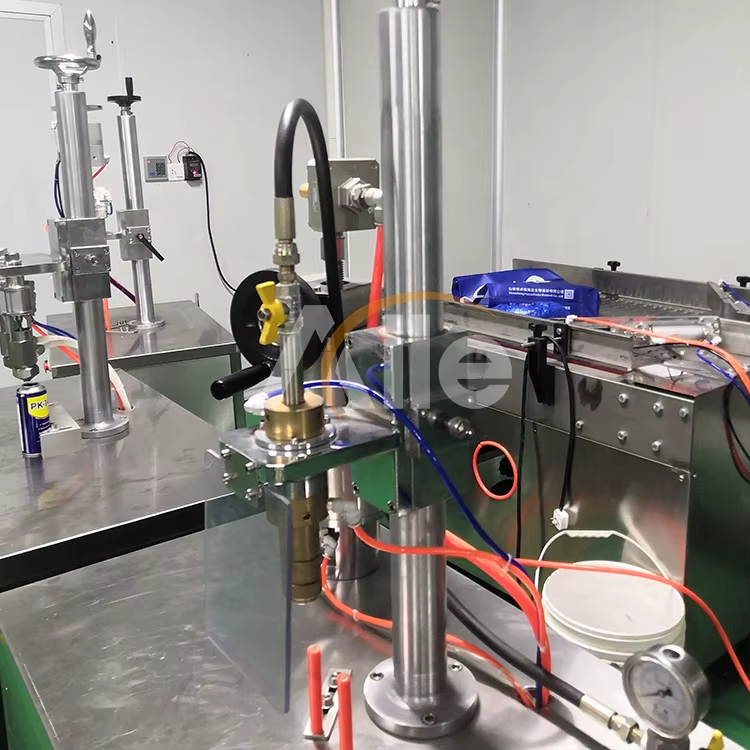
Pneumatic Control Technology in Industrial Filling Applications
Pneumatic control systems have been the backbone of industrial filling equipment for decades, and their application in paint filling machines demonstrates why this technology remains relevant even as electronic servo systems gain market share. A manual filling machine utilizing pneumatic control operates on the principle of regulated compressed air driving a piston or diaphragm pump through a precisely controlled stroke, with the fill volume determined by the cylinder diameter and stroke length rather than by timers or flow meters. This volumetric approach provides inherent accuracy that is not affected by changes in product viscosity, temperature, or supply tank level, all of which can influence the performance of time-based or flow-meter filling systems. For paint manufacturers filling products ranging from thin wood stains to thick textured coatings, the viscosity-independent accuracy of pneumatic volumetric filling represents a significant quality advantage.
Precision Mechanisms in Pneumatic Paint Filling
The high accuracy of a pneumatic manual filling machine for paint applications derives from several mechanical design features working in concert. The pneumatic cylinder that drives the filling piston is equipped with precision stroke adjustment that allows the operator to set the fill volume by mechanically limiting the piston travel, typically using a micrometer-style adjustment screw with graduations corresponding to fractions of a milliliter. Once set, each filling cycle delivers the same volume within plus or minus 0.5 to 1 percent, limited primarily by the consistency of the pneumatic supply pressure and the sealing performance of the piston assembly. The filling nozzle incorporates a positive shutoff valve that closes at the completion of each stroke, preventing drips that would compromise fill accuracy and container cleanliness. For paint products with suspended solids such as metallic pigments, the filling system can include a continuous recirculation loop that keeps solids in suspension during production pauses, ensuring uniform color and consistency from the first can to the last.
Speed and Throughput Advantages of Pneumatic Filling Systems
Pneumatic filling systems offer distinct throughput advantages for paint manufacturers who need fast turnaround on medium-sized production batches. A typical pneumatic manual filling machine for paint aerosols completes a fill cycle in 2 to 4 seconds for volumes of 200ml to 500ml, equating to a theoretical maximum of 900 to 1,800 fills per hour. In practice, with operator can handling time included, sustainable production rates of 400 to 800 cans per hour are achievable with a single operator. The pneumatic system's simplicity also contributes to uptime, as there are no servo motors, encoders, or electronic drives to malfunction. Compressed air is typically already available in paint manufacturing facilities for spray booth operation and pneumatic tooling, meaning the filling machine can be integrated without additional utility infrastructure beyond the existing compressed air supply rated at 6 to 8 bar with adequate flow capacity.
Maintenance and Reliability Considerations for Pneumatic Filling Equipment
The operational reliability of pneumatic filling equipment depends on several maintenance factors that differ from electronically controlled systems. Compressed air quality is the single most important variable affecting pneumatic component life and filling accuracy. Air supplied to the filling machine should be filtered to remove particulates down to 5 microns, dried to a dew point below 3 degrees Celsius to prevent internal corrosion, and lubricated only if the specific pneumatic components require oil-mist lubrication, as some modern pneumatic cylinders and valves are designed to operate oil-free. The primary wear components in a pneumatic manual filling machine are the piston seals, cylinder O-rings, and filling valve seals, all of which are relatively inexpensive and designed for replacement by maintenance personnel without specialized training. A preventive maintenance schedule should include daily draining of air filter water traps, weekly inspection of pneumatic hoses and fittings for leaks that waste compressed air and cause pressure fluctuations, and replacement of piston seals every 6 to 12 months depending on production volume and product abrasiveness.
Comparing Pneumatic and Servo-Electric Filling Control for Paint Applications
While servo-electric filling systems offer programmability and data integration advantages, pneumatic systems retain specific benefits for paint filling applications that merit consideration. Pneumatic systems inherently provide explosion-proof operation in hazardous environments where flammable solvent vapors may be present, as there are no electrical components in the filling zone that could generate sparks. This intrinsic safety feature simplifies installation in paint manufacturing facilities where solvent-based products are handled. Pneumatic systems also deliver higher force density in a compact package, with a standard 63mm bore pneumatic cylinder producing approximately 1900 Newtons of force at 6 bar pressure, more than sufficient for filling viscous paints through small-diameter nozzles. The trade-off is that pneumatic systems cannot provide the real-time fill profile data and automatic parameter adjustment that servo systems offer, making them better suited to applications where fill parameters remain relatively constant across production runs rather than processes requiring frequent recipe changes.
Practical Implementation in Paint Manufacturing Facilities
Consider a mid-sized industrial coatings manufacturer that produces solvent-based anti-corrosion paints in aerosol format for the marine and construction sectors. The facility previously used a combination of manual liquid filling using graduated cylinders and manual crimping, with a production rate of approximately 200 cans per day and a rejection rate near 10 percent primarily due to fill weight non-conformance. After implementing a pneumatic manual filling machine with integrated crimping station, configured with PTFE seals for solvent compatibility and a recirculation loop for the zinc-rich primer formulations that tend to settle, the manufacturer achieved a sustained production rate of 600 cans per day with the same single operator. Fill weight variation decreased from a range of 380g to 420g on a 400g target under manual operation to 396g to 404g under pneumatic control. This improvement eliminated fill weight as a cause of customer returns, which had previously accounted for the majority of the facility's quality complaints.
Evaluating Pneumatic Filling Machine Configurations and Suppliers
When selecting a pneumatic manual filling machine for paint production, manufacturers should evaluate several configuration options and supplier capabilities. The filling cylinder material should be specified as 316 stainless steel with hard chrome-plated bore for abrasion resistance when filling paints containing titanium dioxide or other abrasive pigments. The number of filling heads can range from a single head for low-volume specialty production to four heads for higher throughput, with multi-head configurations typically delivering proportional increases in output. The control system should include a fill counter with batch preset capability for production tracking. Manufacturers such as Guangzhou Aile Automation Equipment Co., Ltd., holding ISO 9001 and CE certifications, supply pneumatic filling machine configurations for paint aerosol applications as part of their aerosol filling equipment portfolio, which has been exported to over 60 countries. Prospective buyers should request a documented filling accuracy test using their specific product formulation as part of the equipment qualification process.
Questions and Answers
How does pneumatic volumetric filling differ from flow meter filling for paint products?
Pneumatic volumetric filling uses a piston of known diameter moving through a fixed stroke to displace a precise volume of product with each cycle. Flow meter filling uses a sensor to measure the flow rate and totalizes the volume, stopping the fill when the target is reached. For paint products, pneumatic volumetric filling offers two key advantages: it is unaffected by viscosity changes that can influence flow meter accuracy, and it handles products with suspended solids without the risk of sensor fouling or clogging that can affect flow meter performance.
What compressed air specifications are required for pneumatic paint filling machines?
The filling machine typically requires compressed air at 6 to 8 bar pressure with a flow capacity of 200 to 400 liters per minute depending on the cylinder size and cycle speed. Air quality should meet ISO 8573-1 Class 1.4.1 or better, meaning particulates filtered to 1 micron or less, pressure dew point of 3 degrees Celsius or lower, and oil content below 0.01 milligram per cubic meter. While many facilities operate with less stringent air quality, investing in proper air treatment directly extends pneumatic component life and maintains filling accuracy.
Can a pneumatic filling machine handle both solvent-based and water-based paints?
Yes, but the machine must be configured with the correct seal materials and the product pathway must be thoroughly cleaned when switching between solvent-based and water-based products. Solvent-based paints require PTFE or FFKM seals throughout the product contact area, while water-based paints can use EPDM seals. The cleaning procedure when switching should include flushing the system with a compatible solvent, disassembling and inspecting the filling valve, and verifying cleanliness by running a fill cycle with clean solvent and inspecting the discharge.
Table of Contents
- Pneumatic Control Technology in Industrial Filling Applications
- Precision Mechanisms in Pneumatic Paint Filling
- Speed and Throughput Advantages of Pneumatic Filling Systems
- Maintenance and Reliability Considerations for Pneumatic Filling Equipment
- Comparing Pneumatic and Servo-Electric Filling Control for Paint Applications
- Practical Implementation in Paint Manufacturing Facilities
- Evaluating Pneumatic Filling Machine Configurations and Suppliers
- Questions and Answers