
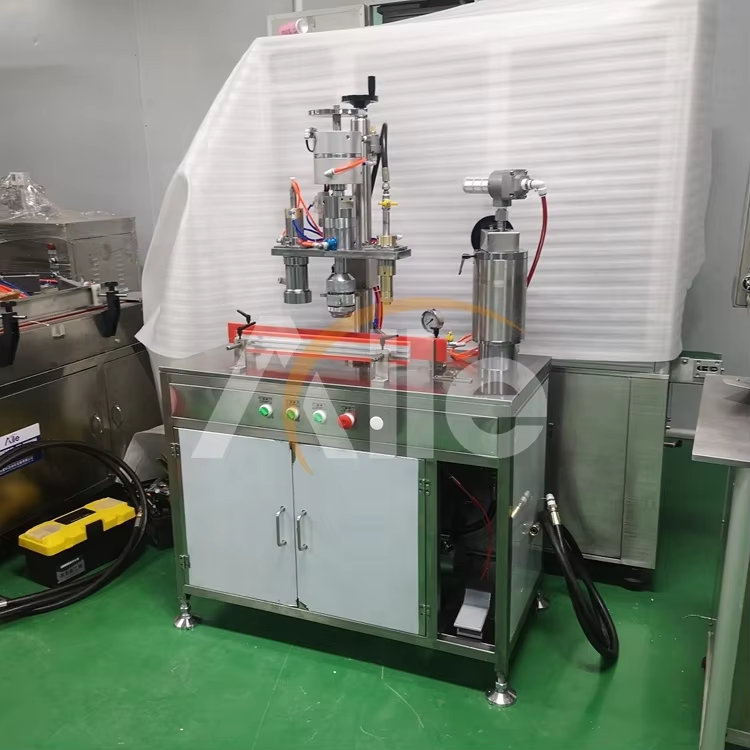
Precision Filling Accuracy: Why Manual Filling Machines Excel with Viscous and Variable-Volume Formulations
Tactile Control and Real-Time Fill Density Adjustment for High-Viscosity Liquids
Manual filling machines deliver unmatched precision for viscous formulations—such as gels, suspensions, and nutraceutical oils—through direct operator haptic feedback. Skilled technicians detect subtle viscosity shifts mid-fill and instantly adjust plunger pressure or speed, preventing air entrapment in thick creams or phase separation in suspensions. This real-time intervention sustains ±1% volumetric accuracy where automated systems falter due to inconsistent flow dynamics. For temperature-sensitive or particulate-laden materials, operators slow fill rates to ensure complete cavity displacement and uniform density. Process validation studies confirm this tactile control reduces product waste by 19% compared to preset automated systems when handling high-viscosity oils and suspensions.
Sub-Milliliter to 100+ mL Range with Consistent ±1% Accuracy
Piston-driven manual fillers maintain pharmaceutical-grade accuracy across an exceptionally broad volume range—from 0.1 mL clinical trial doses to 150 mL production runs—without recalibration. Their mechanical simplicity avoids electronic drift common in thermal or Coriolis-based flow meters, especially critical for biologics and serums prone to viscosity shifts with ambient temperature changes. Operators verify volume directly between fills using calibrated syringes or gravimetric checks, ensuring traceability and consistency. Positive-displacement action prevents sedimentation during filling of particulate-loaded formulations, preserving homogeneity. Manual calibration verification every 10 units sustains long-run accuracy—particularly valuable when automated systems require frequent revalidation to handle variable rheology.
Operational Flexibility: Rapid Adaptation Across Containers, Viscosities, and Formulations
Tool-Free Switchover Between Capsules, Bottles, Syringes, and Blister Trays
Manual filling machines support rapid, tool-free reconfiguration across diverse packaging formats—including 0.5 mL capsules, multi-dose bottles, prefilled syringes, and blister trays—in under five minutes. This agility eliminates retooling costs and cuts changeover downtime by up to 70% versus automated lines. Small-batch producers benefit most: concurrent product lines, limited SKU runs, and prototyping cycles proceed without scheduling bottlenecks. The absence of complex programming or robotic end-effector swaps means flexibility scales linearly with operator skill—not capital investment.
Reliable Handling of Thin Serums, Thick Gels, Suspensions, and Particulate-Loaded Formulas
Manual systems consistently achieve ±1% fill accuracy across the full rheological spectrum. Low-surface-tension serums dispense cleanly via tapered nozzles without dripping; high-viscosity gels and suspensions transfer uniformly under adjustable pressure; and particulate-loaded formulas up to 1,500 cP flow reliably without clogging or segregation. Unlike fixed-parameter automation, operators modulate stroke depth, dwell time, and back-pressure in real time—compensating for batch-to-batch variability in raw material properties. This adaptability ensures process robustness where formulation inconsistency would otherwise trigger out-of-spec fills.
Strategic Value for Small-Batch Producers: Startups, Compounding Pharmacies, and Clinical Prototyping
Cost-Effective Entry and Scalable Workflow for Nutraceutical Startups (<500 Units/Batch)
Nutraceutical startups gain immediate operational leverage with manual filling machines: entry-level units cost $15k–$50k—far below six-figure automated alternatives—and require no dedicated utilities or facility modifications. They enable precise small-batch production (50–500 units) essential for validating market demand, testing niche formulations like CBD tinctures or probiotic suspensions, and minimizing inventory risk. Formulation changeovers take under 15 minutes via intuitive mechanical adjustments—not software reprogramming—supporting rapid iteration. Crucially, ±1% accuracy is maintained even with challenging particulate suspensions, enabling reliable pilot-scale data without regulatory compromise. This pay-as-you-grow model aligns with cash-flow realities: 73% of early-stage nutraceutical ventures cite equipment capital as their top operational barrier, according to industry benchmark reports.
Regulatory Responsiveness in cGMP-Compliant Compounding and Phase I/II Trial Material Production
Manual filling machines enhance regulatory readiness for compounding pharmacies and clinical trial material producers by embedding traceability into the process itself. Operators document fill parameters, environmental conditions, and real-time adjustments directly in batch records—creating auditable, human-verified logs that satisfy cGMP requirements for sterile compounding and investigational drug manufacturing. During Phase I/II trials—where dosage forms frequently evolve—technicians modify fill volumes on-the-fly without revalidation delays, cutting clinical supply lead times by 30–50%. Tactile verification further ensures homogeneity in antibody suspensions or nanoparticle formulations, preventing compliance-critical deviations tied to particulate distribution.
FAQ
What makes manual filling machines better for viscous formulations?
Manual filling machines excel in viscous formulations due to their real-time haptic feedback, allowing operators to adjust pressure and speed dynamically for consistent volume accuracy and reduced waste.
Can manual filling machines handle a variety of fill volumes?
Yes, they sustain pharmaceutical-grade accuracy across a wide volume range, from as low as 0.1 mL to over 150 mL without recalibration.
Are manual filling machines cost-effective for small businesses?
Absolutely. Their entry-level cost, tool-free changeover, and absence of extensive infrastructure requirements make them ideal for startups, compounding pharmacies, and clinical prototyping.
Do manual filling machines meet regulatory standards?
Yes, they enhance regulatory compliance by embedding traceability into the process, with human-verified logs that meet cGMP needs for sterile and investigational manufacturing.
How do manual filling machines handle formulation variability?
Operators can adapt stroke depth, dwell time, and back-pressure in real-time to accommodate variations in formulation properties, ensuring consistent accuracy across different material viscosities.
Table of Contents
- Precision Filling Accuracy: Why Manual Filling Machines Excel with Viscous and Variable-Volume Formulations
- Operational Flexibility: Rapid Adaptation Across Containers, Viscosities, and Formulations
- Strategic Value for Small-Batch Producers: Startups, Compounding Pharmacies, and Clinical Prototyping
-
FAQ
- What makes manual filling machines better for viscous formulations?
- Can manual filling machines handle a variety of fill volumes?
- Are manual filling machines cost-effective for small businesses?
- Do manual filling machines meet regulatory standards?
- How do manual filling machines handle formulation variability?