
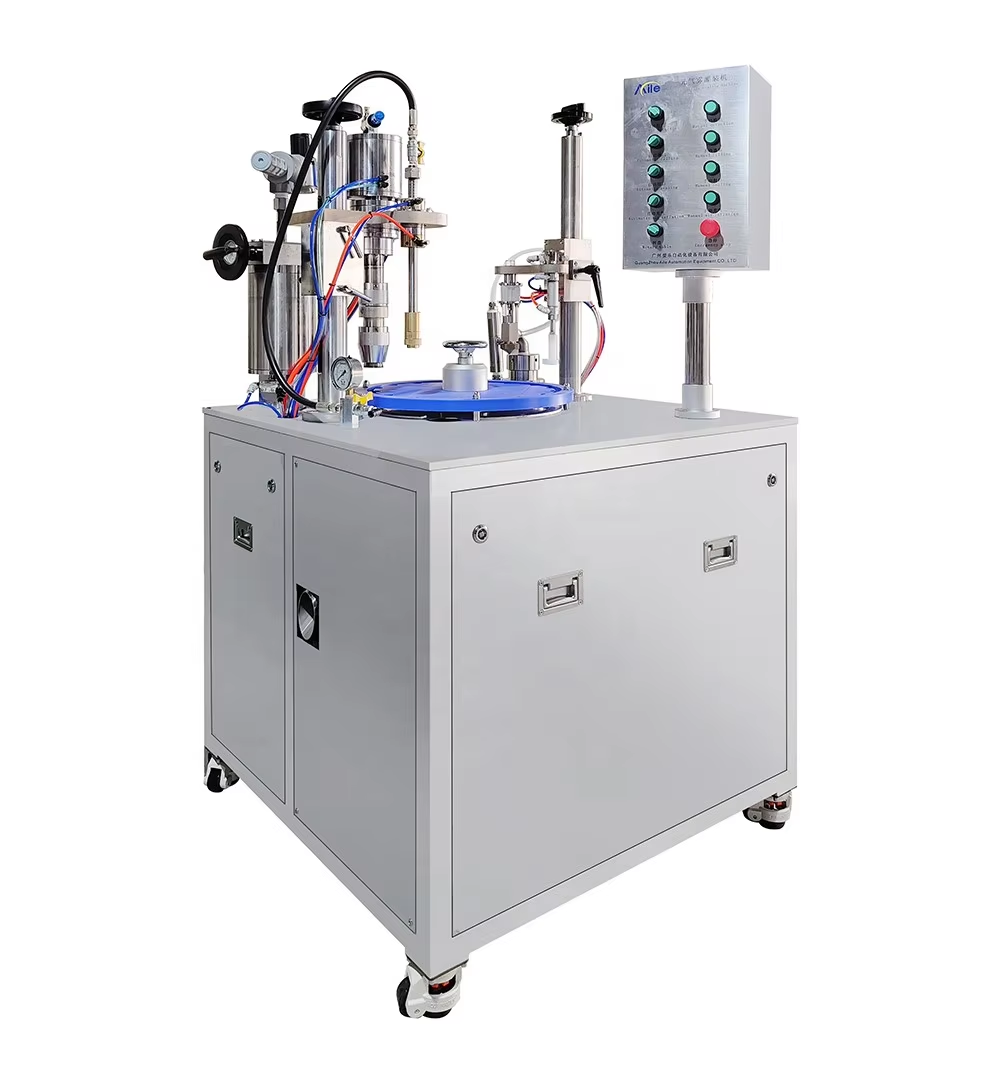
Understanding the Standard Aerosol Filling Machine and Its Role in High-Volume Production
What Defines a Standard Aerosol Filling Machine
The typical aerosol filling machine comes with three main parts: heads that measure out just the right amount of product, injectors that put in the pressurized gas, and crimping mechanisms that lock those valves shut tight. These machines are built for factory floors and can hit fill accuracy down to plus or minus half a percent according to ISO 9001 standards, which means they meet all those tough safety requirements manufacturers have to follow. Newer models handle things like checking for leaks and aligning valves automatically, so workers don't need to mess around adjusting stuff by hand anymore. They crank out anywhere between 300 and 600 cans every hour, something that matters a lot in sectors such as cosmetics and medicine where precision really counts.
How Automation Enhances High-Volume Output in Aerosol Manufacturing
Modern aerosol filling machines cut down on manual labor so much that humans only need to step in for around 5% of the whole production process thanks to things like robotic can positioning and those smart feedback systems. The boost in productivity is massive too - we're talking about anywhere from 60 to 80 percent better output than what semi automatic setups can manage according to some recent industry benchmarks from last year. These machines have real time sensors that tweak how much gets filled into each can depending on changes in propellant pressure, which stops those costly underfill issues that apparently set back manufacturers about seven hundred forty thousand dollars every year according to research by Ponemon Institute. Most forward thinking companies in this sector are jumping on board with these automated solutions because they scale so well, easily handling production runs exceeding one million units per month when needed.
Rotary vs. Linear: Why Rotary Aerosol Filling Machines Excel in Scalability
Rotary aerosol filling machines dominate high-volume manufacturing environments where scalability and speed are non-negotiable. Their circular design enables simultaneous filling at multiple stations, making them fundamentally better suited for scaling operations than linear systems.
Advantages of Rotary Filling Systems in High-Speed Production
Rotary machines achieve throughputs of 100–500+ containers per minute, far exceeding linear fillers’ 10–120-container range. This is due to their continuous motion operation, which eliminates the start-stop cycles inherent to linear systems. Industry studies show rotary designs reduce downtime by 22–37% in 24/7 aerosol production environments by minimizing mechanical wear.
Throughput Comparison: Rotary vs. Linear Aerosol Filling Machines
| Metric | Rotary Systems | Linear Systems |
|---|---|---|
| Max Containers/Min | 500+ | 120 |
| Annual Output* | 260M+ units | 63M units |
| Floor Space | 15–25m² | 8–12m² |
| Scalability | Modular expansion | Fixed capacity |
| Based on 3-shift operations, 260 working days/year |
Scaling Production Capacity with Modular Rotary Designs
Modern rotary aerosol filling machines use modular components that let manufacturers incrementally add 2–12 filling heads without replacing core systems. This adaptability reduces capital expenditure by 35–50% when expanding lines, as demonstrated by a European deodorant producer that doubled its output within 18 months using phased upgrades.
Precision and Automation Minimize Waste in Aerosol Filling Processes
Modern aerosol filling machine systems leverage precision engineering and automation to reduce material waste by up to 12% compared to semi-automated alternatives. This optimization stems from two core technical advancements: minimizing human error and standardizing fill volumes across production cycles.
Reducing Human Error Through Automated Filling Systems
Automated systems eliminate manual handling errors by using servo-driven actuators and infrared sensors to position containers with ±0.5 mm accuracy. Integrated pressure monitoring ensures propellant gas is dispensed within 1–2 PSI tolerance ranges, preventing underfilled cans (which risk product failure) or overfilled units (which waste materials).
Consistent Fill Volumes and Reduced Product Loss
Advanced volumetric pumps and flow meters maintain fill consistency across all nozzle stations, even at 200+ cans/minute speeds. This precision reduces product loss to <0.3% per batch–critical for high-value formulations like pharmaceuticals. Automated purge cycles further prevent cross-contamination between batches, protecting both product integrity and raw material inventories.
By synchronizing mechanical accuracy with programmable logic controls, manufacturers achieve near-zero waste thresholds while meeting strict FDA and ISO quality standards. This precision-first approach directly translates to higher profit margins: a single 1% reduction in aerosol propellant waste can save $42,000 annually for mid-sized producers.
Long-Term Cost Savings and ROI of Standard Aerosol Filling Machines
Lower Operational Costs via Reduced Labor and Downtime
Standard aerosol filling machines reduce operational expenses by automating tasks traditionally requiring 3–5 technicians. Predictive maintenance protocols and self-diagnostic features minimize unplanned downtime by 25–40%, while automated valve crimping and filling cycles eliminate human error in repetitive tasks.
Evaluating ROI: Investment Payback Period for Automatic Aerosol Filling Machines
Most manufacturers achieve full ROI within 18–36 months. This payback period reflects labor savings (up to 60% in high-volume operations), reduced product waste from precision filling (±0.5% volume accuracy), and increased throughput–2,000–4,000 units/hour versus 800–1,200 units in manual setups.
Industry Trend: Growing Shift Toward Automated Solutions for Cost Efficiency
75% of aerosol producers now prioritize automated systems to offset rising labor costs and volatile raw material prices. This aligns with broader manufacturing trends, where automation adoption grows 12% annually to maintain margins in competitive markets like personal care and industrial coatings.
FAQ
What is an aerosol filling machine?
An aerosol filling machine is specialized equipment used to fill cans with liquid products and pressurized gas, commonly used in the production of various sprays like cosmetics, medical products, and household items.
How does automation improve aerosol filling machines?
Automation enhances the efficiency and precision of aerosol filling machines by incorporating features such as robotic can positioning and smart feedback systems, reducing the need for manual labor and minimizing human error.
Why are rotary aerosol filling machines preferred for scalability?
Rotary aerosol filling machines are preferred because of their ability to fill multiple containers simultaneously, offering higher throughput and reducing mechanical wear, making them ideal for high-volume production environments.
What are the benefits of using automated aerosol filling machines?
Automated aerosol filling machines offer benefits such as increased production speed and accuracy, reduced labor costs, minimized product waste, and scalable operations, leading to better long-term cost savings and ROI.
Table of Contents
- Understanding the Standard Aerosol Filling Machine and Its Role in High-Volume Production
- Rotary vs. Linear: Why Rotary Aerosol Filling Machines Excel in Scalability
- Precision and Automation Minimize Waste in Aerosol Filling Processes
- Long-Term Cost Savings and ROI of Standard Aerosol Filling Machines
- FAQ