
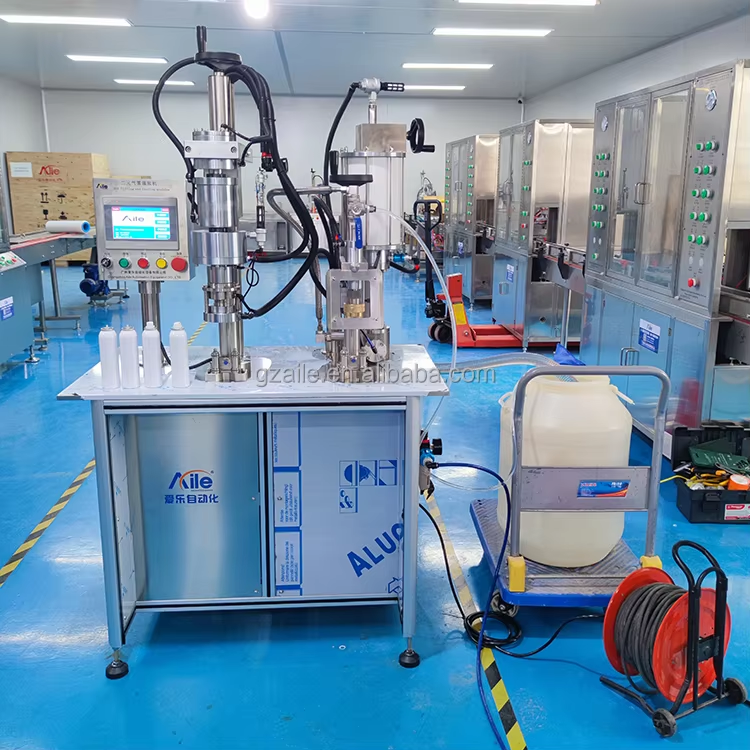
Precision Crimping Mechanisms Ensuring Consistent, Leak-Free Seals
Dual-Stage Radial Compression with Force Calibration
Dual-stage radial compression delivers repeatable, leak-free aerosol valve seals through precision alignment and controlled force application. In the first stage, guided alignment arms center the valve to eliminate lateral displacement—preventing misalignment-related leaks before crimping begins. The second stage applies calibrated radial pressure between 120–180 Newtons, adjustable for canister material (e.g., aluminum vs. tinplate) and valve thickness. Force calibration profiles guard against both under-compression—leading to seal failure—and over-compression, which risks damaging elastomeric seals or deforming valve stems. Digital force gauges maintain accuracy within ±1% across production runs. Operating at 40+ containers per minute, this system achieves a 99.2% leak-free crimp rate, reducing seal failures by 34% compared to single-stage alternatives after manual filling.
Real-Time Pressure Feedback Loop (±0.5N Tolerance)
Embedded load cells monitor crimping pressure continuously, executing up to 200 micro-adjustments per second to sustain ±0.5 Newton tolerance. This closed-loop control dynamically compensates for real-world variables—including material inconsistencies, thermal expansion, and tooling wear—without operator intervention. When deviations exceed preset thresholds, the system initiates automatic recalibration; persistent violations trigger an immediate shutdown after 0.8 seconds to prevent defective units from progressing. Integrated data logging captures the full pressure curve for every crimp, supporting traceability and quality audits. Validated across ambient conditions from –20°C to 50°C, this system cuts scrap rates by 27% while preserving seal integrity under thermal stress.
Semi-Automatic Integration with Manual Filling Machines
Operator-Assisted Valve Placement Using Visual Alignment Guides
Operators position valves using laser-guided markers and ergonomic staging platforms, ensuring correct orientation and vertical alignment prior to crimping. Designed for human-centered operation, the visual alignment system reduces placement errors by 92% versus unassisted manual estimation, as confirmed in peer-reviewed packaging ergonomics research. It supports diverse valve geometries—including metered-dose inhalers, cosmetic sprayers, and industrial actuators—while sustaining a consistent 15-second cycle time. A color-coded alignment indicator requires positive confirmation before activation, eliminating misfires and associated material waste.
Seamless Handoff Protocol from Manual Filling Machine to Crimping Station
A sensor-synchronized conveyor transfers filled containers directly from manual filling machines to the crimping station without manual rehandling. Sensor-triggered clamping secures each canister during transit, preserving fill volume and preventing spillage or tilt-induced valve misseating. This integrated handoff eliminates handling gaps, cutting transfer time by 70% and improving line continuity. Facilities adopting this protocol report 40% higher throughput than those using disconnected, manually bridged workflows—data validated by independent aerosol assembly benchmarks.
Tooling Flexibility and Compliance for Diverse Aerosol Packaging
Interchangeable ISO 8535-1–Compliant Die Sets (20–35mm Neck Finishes)
Modern semi-automatic crimpers use standardized, interchangeable die sets compliant with ISO 8535-1—the international standard governing aerosol valve crimping geometry and performance. These dies support neck finishes from 20 mm to 35 mm, enabling rapid format changes across cosmetics, pharmaceuticals, household cleaners, and industrial products. Tool-free die swaps take under 90 seconds and require no recalibration, maintaining process consistency across material types: aluminum, tinplate, and laminated plastics alike. For facilities pairing crimpers with manual filling machines, this compliance-driven flexibility reduces changeover downtime by 70% while upholding leak-tight performance across all SKUs.
Reliability Enhancements: Maintenance Efficiency and Uptime Optimization
Semi-automatic crimpers maximize operational reliability through purpose-built serviceability and predictive maintenance. Modular design allows field replacement of high-wear components—such as compression jaws—in under 10 minutes, using only standard tools. Integrated self-diagnostic systems continuously track motor torque signatures and bearing temperatures, flagging anomalies before they escalate into unplanned stoppages during critical sealing cycles. This predictive approach reduces corrective maintenance events by 25–40% compared to reactive models. Standardized lubrication points and service intervals align seamlessly with manual filling machine maintenance schedules, contributing to a verified 99.5% operational uptime—eliminating bottlenecks in high-mix, high-volume aerosol packaging environments.
FAQ
What is dual-stage radial compression?
Dual-stage radial compression is a process for crimping aerosol valves that involves two stages of force application to ensure leak-free seals. The first stage centers the valve to prevent misalignment, and the second stage applies calibrated pressure to secure the seal.
How does the real-time pressure feedback loop work?
The real-time pressure feedback loop uses load cells to continuously monitor crimping pressure, making micro-adjustments to maintain pressure within a ±0.5 Newton tolerance. This ensures consistent quality despite varying conditions.
What advantages does semi-automatic integration offer?
Semi-automatic integration combines manual entry with automation to enhance precision and reduce error rates significantly. It also improves productivity by reducing placement errors and enhancing operator efficiency through automated handoff protocols.
Are the crimpers flexible for different aerosol packaging?
Yes, the crimpers use interchangeable, ISO 8535-1–compliant die sets, allowing them to accommodate various neck finishes and product types such as cosmetics, pharmaceuticals, and household cleaners, ensuring swift changeovers and maintained consistency.
How is maintenance efficiency achieved?
Maintenance efficiency is achieved through modular design, allowing quick replacement of high-wear parts, self-diagnostics for early anomaly detection, and synchronized maintenance schedules, leading to increased operational reliability and uptime.