
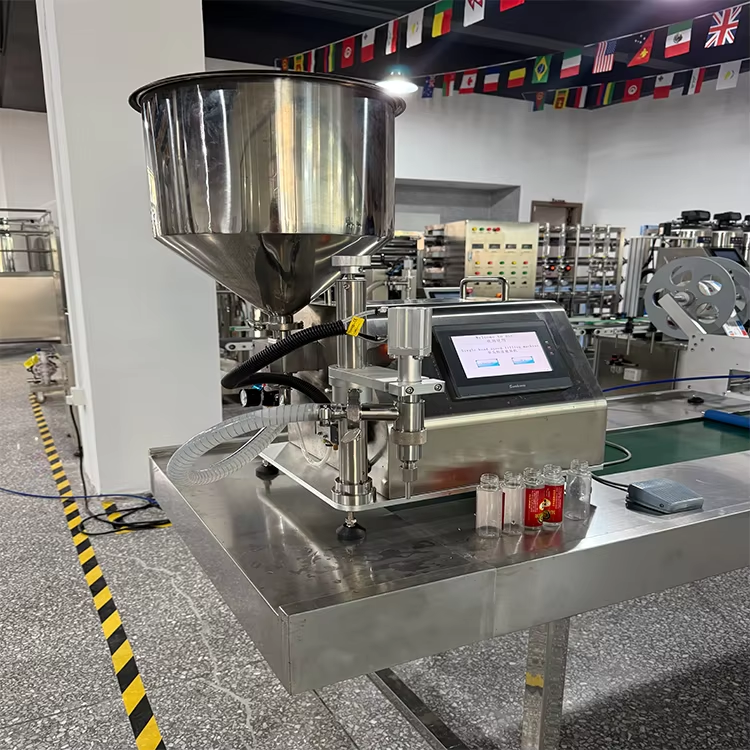
Precision & Consistency: Eliminating Human Error from Body Spray Filling
How Semi-Automatic Filling Ensures ±0.5% Fill Accuracy for Low-Viscosity Aerosols
Semi-automatic body spray filling machines achieve pharmaceutical-grade precision—±0.5% fill variance—using servo-driven volumetric pumps and closed-loop pressure sensors. This level of control is essential for low-viscosity formulations like alcohol-based perfumes, which are highly susceptible to flow fluctuations during transfer. In contrast, manual “fill-by-eye” methods routinely deliver ±3–5% dosage inconsistency due to operator variability in trigger pressure, timing, and fatigue.
The operational impact is clear:
| Filling Method | Accuracy Range | Product Waste Rate |
|---|---|---|
| Manual Filling | ±3% – ±5% | 5–7% per batch |
| Semi-Automatic | ±0.5% – ±1% | <0.8% per batch |
Automated nozzle shutoff valves eliminate post-fill drips during canister changes, while real-time flow meters dynamically compensate for viscosity shifts caused by temperature or formulation differences. As a result, rework drops by 90% compared to manual processes—where even minor environmental or human variables cause costly over- or under-fills.
Why Manual Filling Machines Fail on Dosage Uniformity—and Damage Brand Reputation
Manual filling machines introduce unavoidable variability that directly undermines regulatory compliance, product performance, and brand equity. Inconsistent thumb pressure on trigger valves leads to underfilled units—failing FDA or EU cosmetic compliance thresholds—or overfilled aerosols that leak during transit. For luxury skincare and fragrance brands, where sensory consistency and dosing reliability define premium perception, such inconsistencies erode consumer trust rapidly.
The financial consequences are substantial: inconsistent fills drive 12–15% raw material waste, and product recalls triggered by under-dosed batches average $740,000 per incident (Ponemon Institute, 2023). With rising consumer expectations for reliability in personal care aerosols—and increased scrutiny from regulators and e-commerce review algorithms—these risks compound faster than traditional cost models account for.
Operational Flexibility: Adapting Quickly Without Full Automation Costs
Semi-automatic body spray filling machines deliver strategic agility that manual systems cannot match—enabling rapid response to market shifts without the capital, complexity, or lead time of full automation.
Rapid Changeovers Between SKU Sizes and Formulations (e.g., Deodorant vs. Perfume Mists)
Switching between SKUs takes minutes—not hours. Programmable parameters allow instant adjustments for container size (50ml to 200ml), actuator force, and dwell time. Transitioning from alcohol-based perfume mists to oil-based deodorant sprays requires only a nozzle swap and updated settings—no mechanical recalibration. This eliminates the 30–45 minute downtime per changeover typical of manual lines, boosting daily throughput by up to 40% (Packaging Throughput Benchmark Report, 2024).
Scalable Workflow Integration: Bridging Manual Filling Machines and Fully Automatic Lines
These systems serve as intelligent stepping stones in production evolution—designed not as endpoints, but as adaptable nodes in a maturing packaging infrastructure. Their modularity supports phased growth:
- Modular design: Add capping, labeling, or leak-testing stations incrementally as volume justifies it
- Hybrid operation: Run semi-automatically during peak demand while retaining manual backup capacity for low-volume SKUs
- Data compatibility: Export fill weight logs, rejection rates, and cycle times directly into ERP or MES platforms for traceability and continuous improvement
This approach avoids the “automation cliff”—the costly binary choice between inefficient manual labor and million-dollar fully automated lines. Production managers report achieving 60% faster ROI when scaling automation incrementally versus wholesale replacement.
Total Cost of Ownership: Why Semi-Automatic Beats Manual Filling Machines Long-Term
Upfront Investment vs. Labor, Waste, and Rework Costs of Manual Filling Machines
While manual filling machines have lower initial purchase prices, their true cost emerges across labor, waste, and unplanned downtime. A typical manual line requires five operators; semi-automatic systems operate reliably with just two—a 60% reduction that delivers $50,000+ in annual labor savings (Beverage Production Quarterly, 2024). Human-dependent processes also generate 15% more material waste from overfills and inconsistent dosing, plus $150/hour in avoidable downtime costs during error correction (Packaging Digest, 2023). Rework—reprocessing underfilled units or scrapping leaking cans—further compresses margins, undermining the perceived affordability of manual equipment.
| Cost Factor | Manual Filling Machine | Semi-Automatic Advantage |
|---|---|---|
| Operators per Line | 5 | 2 (60% reduction) |
| Annual Labor Savings | — | $50,000+ |
| Material Waste | 15% higher | Precision-controlled |
| Downtime Impact | $150/hour | 30–50% less frequent |
ROI Timeline: Payback in <6 Months Through Reduced Spillage, Rejects, and Overtime
Semi-automatic systems typically achieve full payback in under six months—not through equipment depreciation, but by eliminating three persistent manual cost drivers: spillage during transfer, quality rejects from inconsistent fills, and overtime driven by slow, error-prone cycles. Volumetric precision cuts spillage losses by 70%, while automated shutoff valves prevent overfills responsible for 12% of manual-system rejects. Combined with 3× faster changeovers, these efficiencies reduce overtime expenses by 35% and accelerate breakeven to 18–24 weeks for most aerosol operations—validated by a 32% higher 18-month ROI compared to manual alternatives (Beverage Production Quarterly, 2024).
FAQ
What is the main advantage of using semi-automatic filling machines over manual ones?
Semi-automatic filling machines offer higher precision and consistency with a ±0.5% fill accuracy, reducing product waste and operational costs compared to manual filling.
How do semi-automatic machines improve brand reputation?
By ensuring dosage uniformity and compliance with regulatory standards, semi-automatic machines help maintain product quality and consistency, protecting brand reputation.
What cost savings can be achieved with semi-automatic filling systems?
These systems can reduce labor costs by 60%, material waste by 15%, and downtime costs by over $150/hour, achieving a payback period of less than six months.