
Producing aerosol hairspray involves much more than filling liquid into a spray can.
A complete hairspray aerosol product is a combination of the formula, solvent, styling resin, propellant, aerosol can, valve, dip tube, actuator, cap and filling process. A change in any one of these factors can affect filling accuracy, internal pressure, leakage performance, spray pattern and even whether the finished product can be completely discharged from the can.
For this reason, choosing a hairspray aerosol filling machine should start with the actual product and packaging rather than machine speed alone.
Guangzhou Aile Automation Equipment Co., Ltd. provides aerosol filling equipment for both small-batch and large-scale hairspray production, from a semi-automatic 3-in-1 aerosol filling machine to complete fully automatic aerosol filling lines.
This guide explains the practical information hairspray manufacturers should confirm before choosing an aerosol filling solution.
What Is Aerosol Hairspray?
Aerosol hairspray is a pressurized hair styling product designed to form a light film over the hair after spraying.
Depending on the formulation and intended styling effect, hairspray may provide:
- Strong or flexible hold
- Shape retention
- Anti-frizz performance
- Volume
- Shine
- Humidity resistance
- Finishing and styling effects
Unlike a simple liquid spray, a conventional aerosol hairspray is packed in a pressure-resistant aerosol can together with a suitable propellant.
When the actuator is pressed, internal pressure pushes the product through the valve and nozzle. After spraying, volatile solvents evaporate and the styling polymers or resins remain on the hair surface, forming a thin film that creates the required hold and styling effect. This is why hairspray manufacturing requires careful control of both liquid filling and propellant filling.
Common Hairspray Formulas and Ingredients
Different hairspray manufacturers use different formulations, but a conventional aerosol hairspray usually contains several groups of ingredients.
Solvents
Common solvents may include:
- Alcohol denat.
- Ethanol-based solvent systems
- Water
- Isopropyl alcohol
- Other formula-specific solvents
Alcohol is widely used because it evaporates quickly and helps styling polymers spread evenly over the hair. However, water-based or mixed solvent systems can also be used depending on product positioning and formulation requirements.
Styling Polymers and Resins
The styling effect usually comes from film-forming polymers or resins. Examples may include:
- PVP/VA copolymers
- Acrylic copolymers
- Vinyl polymers
- Other film-forming styling resins
After the solvent evaporates, these ingredients remain on the hair and form the film responsible for hold and shape retention. The type and concentration of resin also affect the manufacturing process.
A higher resin concentration or unsuitable filtration system may increase the risk of:
- Product buildup
- Filling valve contamination
- Pipeline deposits
- Nozzle blockage
- Difficult cleaning during product changeover
Therefore, the filling equipment should be selected according to the actual formulation rather than simply treating every hairspray as the same liquid.
Other Ingredients & Propellants
Depending on the product, the formula may also contain neutralizers, stabilizers, fragrance, conditioning ingredients, shine-enhancing ingredients, or anti-static ingredients.
The propellant generates the pressure required to discharge and atomize the product. Possible hairspray propellants include LPG, Propane, Butane, Isobutane, DME, HFC-152a, and other suitable propellants according to formula and market requirements. There is no single propellant that should automatically be selected just because the product is called “hairspray.”
Global Hairspray Market References and Propellant Examples
Existing retail hairspray products can provide useful references when developing a new product, particularly when studying formulation direction, packaging size and propellant systems. However, formulations can vary between countries and can also change over time.
For example, public ingredient information for selected products shows that different brands and markets may use different propellant systems. Some Wella aerosol products list propane, butane and isobutane among their ingredients. Selected Wella EIMI and Sebastian Professional products use DME-based systems. Some L'Oréal Paris Elnett and TRESemmé aerosol hairsprays sold in the North American market use HFC-152a.
Other market references may include products from brands such as got2b, TIGI Bed Head, and Paul Mitchell.
These examples demonstrate an important point: The final propellant choice depends on several factors, including hairspray formulation, solvent system, resin concentration, required internal pressure, target market, local regulations, and production cost. Before configuring an aerosol filling machine, AILE recommends confirming the customer's actual propellant type and filling volume.
Common Hairspray Capacities and Aerosol Can Choices
Hairspray is sold in many different package sizes. Typical market ranges include:
| Nominal Capacity | Typical Application |
|---|---|
| 50–100 ml | Travel size, sample size or portable products |
| 200–250 ml | Medium retail size |
| 300 ml | Common retail and professional salon size |
| 400–500 ml | Large household or professional salon size |
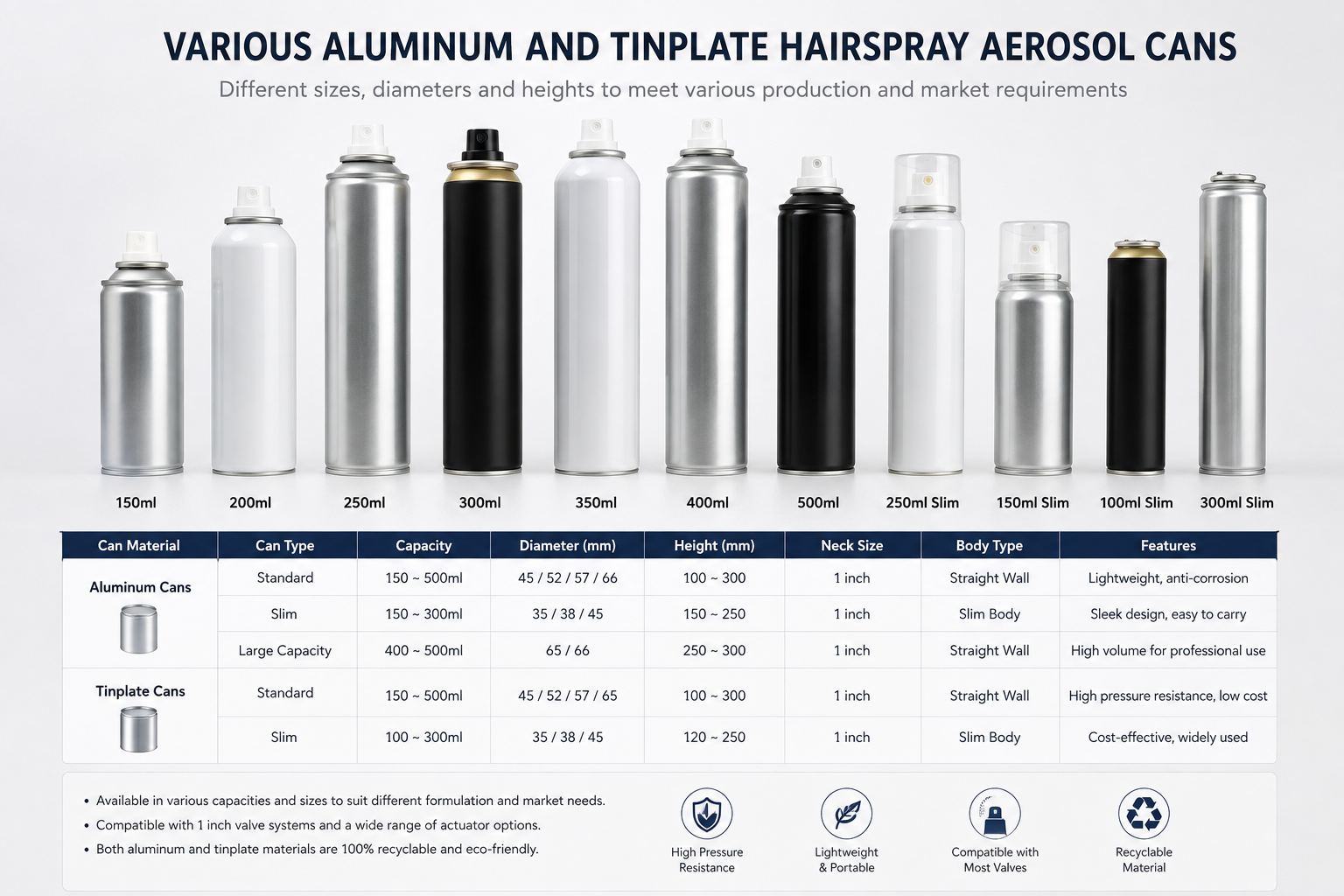
However, nominal product capacity alone is not enough to design an aerosol filling machine. Two different 300 ml aerosol cans may use different diameters, heights and shapes. Before machine production, the machine supplier normally needs to confirm exact technical details like aerosol can material, actual can diameter, total height, and valve specifications.
Common Aerosol Can Diameter Reference
Hairspray aerosol cans are available in many formats. Depending on the can supplier, country, capacity and package design, common aerosol can diameters may include approximately: 45 mm, 50 mm, 52 mm, 53 mm, 57 mm, 60 mm, and 65 mm.
For machine manufacturing, AILE needs the customer's actual aerosol can samples or confirmed technical drawings rather than relying only on the labeled capacity.
Aluminum vs Tinplate Aerosol Cans for Hairspray
Aluminum Aerosol Cans
Aluminum aerosol cans are often selected for personal care and cosmetic products because they provide a smooth external appearance, seamless body construction, and lightweight packaging. They are commonly seen in cosmetic and salon-style packaging, though they may have a higher packaging cost.
Tinplate Aerosol Cans
Tinplate aerosol cans are also widely used for mass-market aerosol products. Advantages may include cost-effective packaging, wide availability, multiple standard diameters, and suitability for high-volume production.
Which One Should You Choose?
The choice should be made according to the complete project, considering product positioning, packaging appearance, can cost, formula compatibility, and order volume. Both aluminum and tinplate hairspray cans can be handled by aerosol filling equipment when the machine is configured correctly.
Aerosol Can, Valve and Actuator Matching
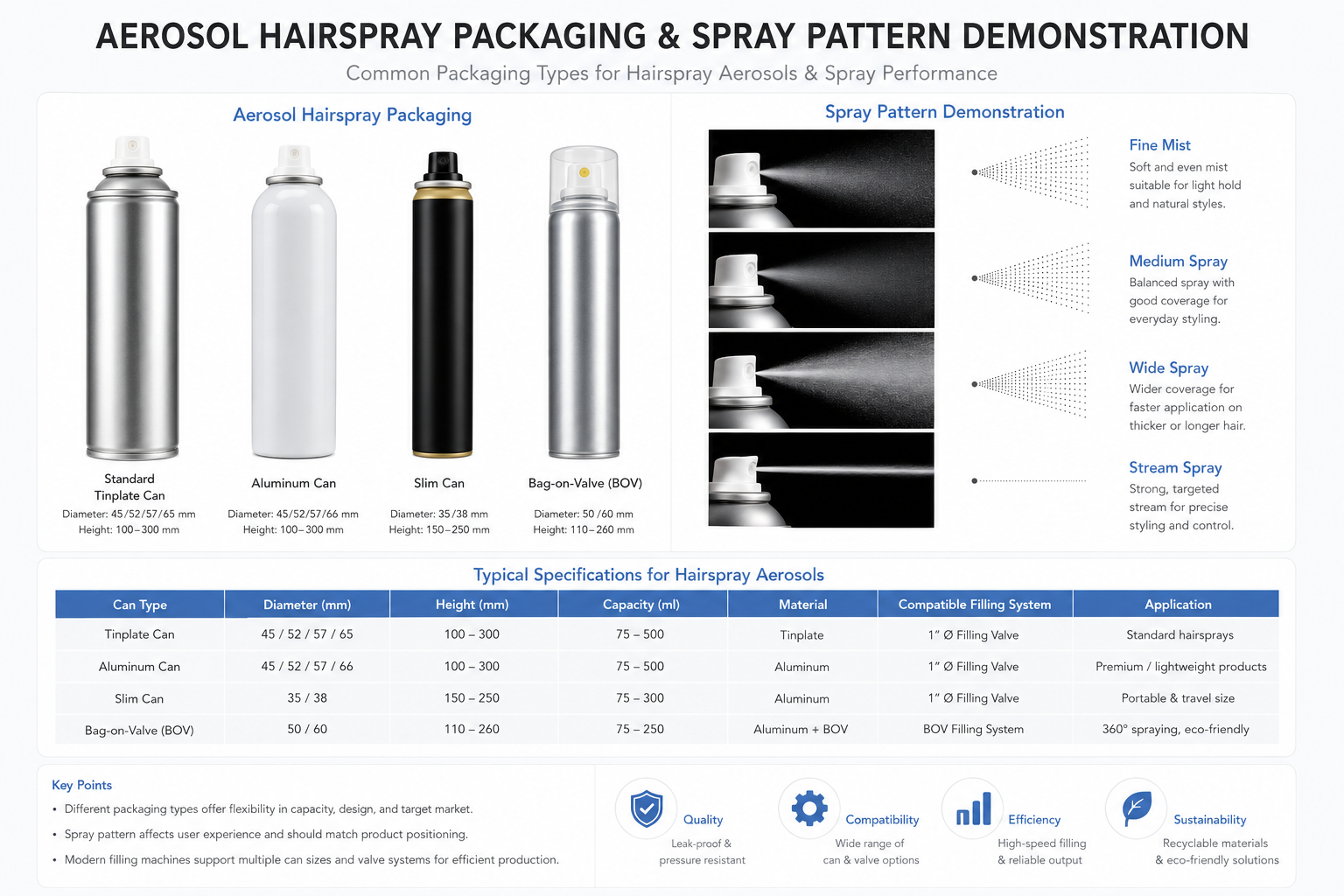
The spray performance of a hairspray does not depend only on the aerosol filling machine. It depends on the complete aerosol packaging system, including formula viscosity, propellant ratio, internal pressure, valve flow rate, and actuator design.
Even if two aerosol cans contain exactly the same formula, changing the valve or actuator can create a noticeably different spray result (e.g., finer, coarser, wider, narrower). Typical packaging problems like nozzle blockage, weak spray, or gas leakage often stem from incorrect matching.
How Hairspray Aerosol Products Are Filled
A conventional hairspray aerosol production process generally follows this sequence:
- Formula preparation and filtration
- Liquid filling
- Valve placement
- Valve crimping
- Propellant filling (LPG, DME, etc.)
- Weight and/or pressure inspection
- Aerosol water bath leak testing
- Can drying
- Actuator and cap pressing
- Coding, labeling and packaging
Semi-Automatic 3-in-1 Hairspray Aerosol Filling Machine
For a new hairspray project or relatively small production volume, a fully automatic line may not always be necessary. AILE's semi-automatic 3-in-1 aerosol filling machine integrates three core processes into one machine: Liquid filling, Valve crimping, and Propellant filling.
Typical Production Capacity: 700–900 cans per hour, with filling accuracy reaching approximately ±1%.
Who Is It Suitable For? New hairspray manufacturers, startup aerosol projects, small-batch manufacturing, and factories with limited production space.
Fully Automatic Hairspray Aerosol Filling Line
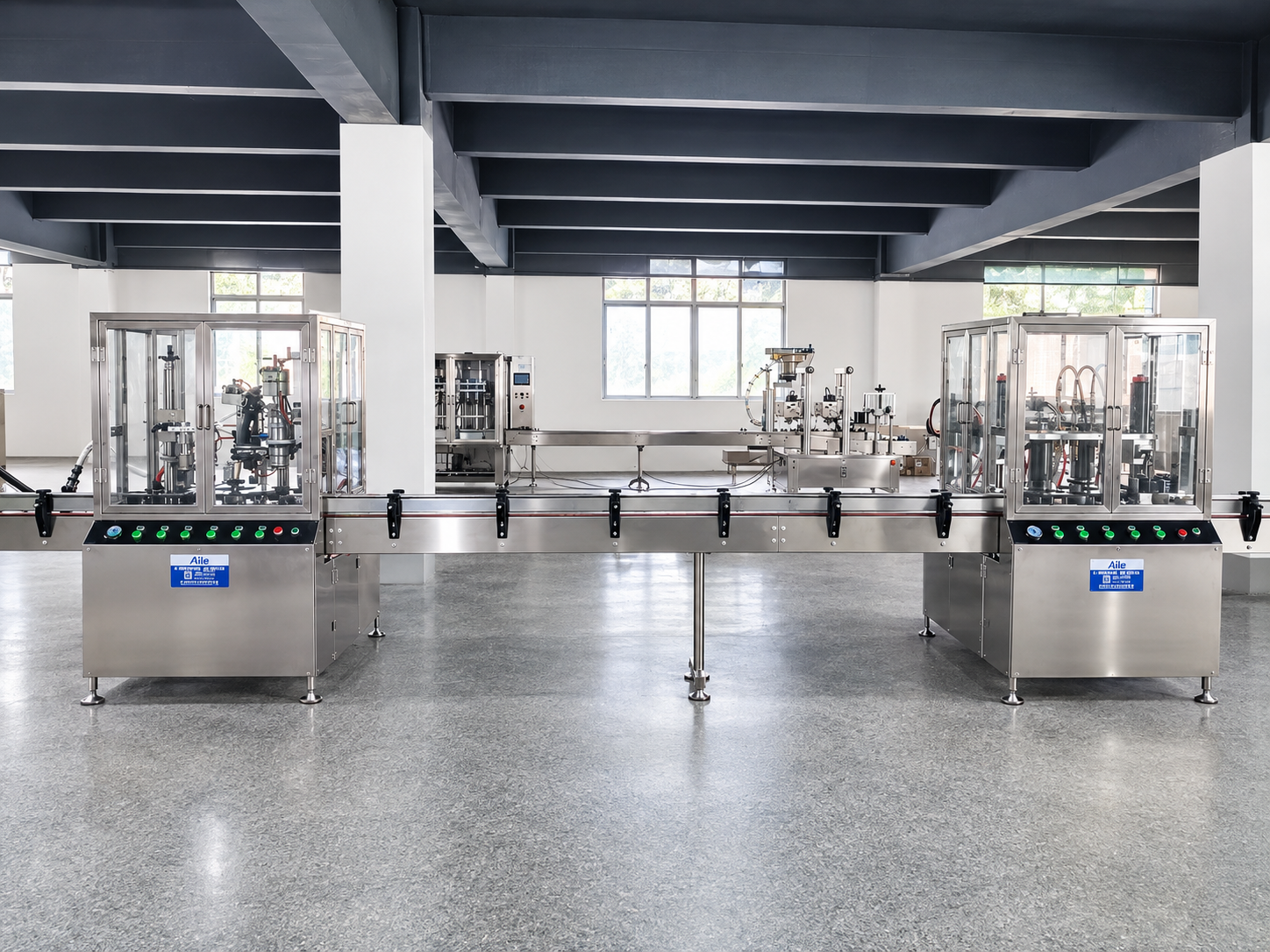
For established hairspray manufacturers and high-volume production, a fully automatic system significantly reduces manual handling. A complete line consists of multiple machines connected by conveyors, handling everything from automatic can feeding to case packing.
Standard Automatic Production Capacity: 2,400–3,600 cans per hour.
High-Speed Automatic Production: 4,800–7,200 cans per hour.
Semi-Automatic Machine vs Fully Automatic Line
| Item | Semi-Automatic 3-in-1 Machine | Fully Automatic Production Line |
|---|---|---|
| Equipment form | One integrated machine | Multiple machines connected by conveyors |
| Core function | Liquid filling + valve crimping + propellant filling | Complete process from filling to inspection and packaging |
| Suitable customer | New projects, small factories, trial production | Established manufacturers, contract fillers, high-volume factories |
| Capacity | Approx. 700–900 cans/hour | Approx. 2,400–3,600 cans/hour (Standard) |
| Labor requirement | More manual handling | Lower manual handling between processes |
| Initial investment | Lower | Higher |
Key Challenges in Hairspray Filling Production
- Alcohol and Flammable Propellants: Production requires explosion-proof electrical configurations, factory ventilation, grounding, and static electricity control.
- Resin and Polymer Buildup: Styling polymers can cause resin deposits in tanks or buildup inside pipelines. Proper filtration and smooth product flow design are essential.
- Propellant Filling Accuracy: Incorrect propellant filling affects internal pressure, spray pattern, and product evacuation.
- Valve Crimping and Leakage: If the crimp is incorrect, the product may gradually lose pressure during transportation.
- Spray Performance Testing: Finished products should be tested for spray pattern, atomization, nozzle blockage, and holding effect.
Quality Control for Finished Hairspray Aerosols
A practical hairspray production quality-control program may include checks on liquid and propellant filling weight, internal pressure, crimping diameter and depth, aerosol can leakage, spray rate, and pressure stability after storage.
Information Required for a Hairspray Filling Solution
To recommend the correct hairspray aerosol filling machine, AILE normally needs information including: Hairspray product type, formula characteristics, liquid/propellant filling volume, can material/diameter/height, valve specification, and required production capacity.
Before machine production, we highly recommend providing actual samples or technical drawings of the can, valve, actuator, and cap.
Why Choose AILE for Hairspray Aerosol Filling Equipment?
Guangzhou Aile Automation Equipment Co., Ltd. focuses on aerosol filling machines and related packaging equipment. Instead of recommending a machine only according to a target speed, AILE evaluates the complete product and packaging configuration. Whether you are developing your first hairspray product or planning to increase an existing factory from manual production to several thousand cans per hour, the machine should be configured around the actual product.
Frequently Asked Questions
Can one semi-automatic machine fill different hairspray can sizes?
Yes, one semi-automatic 3-in-1 aerosol filling machine can often be configured to handle multiple aerosol can sizes, provided the correct molds, fixtures, or machine adjustments are applied.
Is explosion-proof equipment required?
Many conventional aerosol hairsprays contain alcohol and use flammable propellants such as LPG or DME. Therefore, explosion-proof equipment configuration, ventilation, and static control should be considered.
What propellants are commonly used?
Depending on the formula and market, common propellants include Propane, Butane, Isobutane, LPG mixtures, DME, and HFC-152a.
Build the Right Hairspray Aerosol Filling Solution
A hairspray filling project should not begin with the question: “Which aerosol filling machine is the fastest?”
What product are you filling, what packaging are you using, and how many cans do you need to produce? We can evaluate the appropriate machine configuration for your specific project.
Get Your Technical Consultation & QuoteBrand names mentioned on this page are used only as publicly available market references. AILE is not affiliated with or endorsed by these brands. Product formulations and packaging may vary by market and may change over time.